
You are using an outdated browser and your browsing experience will not be optimal. Please update to the latest version of Microsoft Edge, Google Chrome or Mozilla Firefox. Install Microsoft Edge

February 3, 2023

A Review of the Japan-Vietnam Patent Prosecution Highway

Overview

Although Vietnam has a number of mechanisms for accelerating the patent examination process, most of them have not lived up to the expectations of applicants. However, a fast-track patent prosecution highway (PPH) program was opened for the first time between the Intellectual Property Office of Vietnam (IP Office) and the Japan Patent Office (JPO) in January 2016, creating opportunities for all applications originating from Japan.

The PPH program has been rolled out in the following stages:
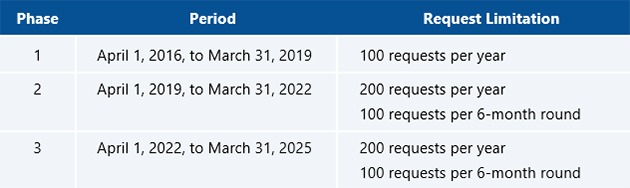
After more than six years of implementation, this program is considered successful and can be extended to support Japanese enterprises in establishing patent rights in Vietnam.

Effectiveness

This program has many advantages, such as:

  • Applications originating from Japan are usually of good quality with clear and coherent specification It is possible that the IP Office’s requirements for specifications are already very consistent with Japanese applicants’ way of drafting specifications thanks to the JPO’s training programs for the IP Office.
  • Patents in Japan usually have a short examination timeline and are granted very quickly, even within the application filing timeline in Vietnam (12 months from the priority date for applications filed under the Paris Convention and 31 months from the priority date for applications filed as PCT national phase applications).
  • The coordination between the JPO and the IP Office has been very good. PPH applications are processed in a quick and efficient manner.
  • Japanese applicants and their representatives also often coordinate well with the IP Office to rectify formality shortcomings and avoid prolongation of the examination period.

Although there are no official statistics from the IP Office, according to independent statistics for applications whose PPH requests were filed by Tilleke & Gibbins’ associate firm (one of the most prolific filers under the PPH), the examination period for applications under the PPH has been significantly shortened, compared to the period for substantive examination as prescribed by law (18 months):

  • The average period for receiving the first office action as from the date of the PPH request is 8.53 months.
  • The average period for receiving a notice of allowance without an office action from the date of requesting PPH is 7.98 months.

Further, the prescribed 18-month time limit for examination is often difficult to achieve for various reasons, and the actual examination period for applications not under the PPH program is typically much longer than 18 months in practice. Obviously, the PPH has been providing a tremendous time benefit to Japanese applicants.

Current Status

Since its inception, the PPH program has attracted the attention of many Japanese enterprises and industrial property representatives in Vietnam. In fact, in the first rounds of this program, the timeline for the number of requests to reach the limit was often very short, and in many cases the limit was reached on the very first day the round was opened.
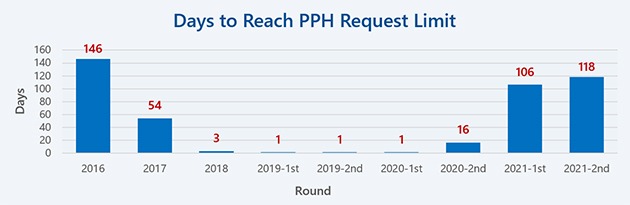
However, despite the PPH’s apparent effectiveness, recent monitoring of the number of applications as well as the time limit for filing PPH requests shows that this program has not been attracting the attention of Japanese applicants as much as before. According to the above figure, the number of days to reach the request limit has increased in every period since 2020. By 2022, the first round, which was opened on April 1, 2022, had not even reached 100 requests after six months, and the 34 remaining spots were moved to the second round, which was opened on October 1, 2022.

It is not clear why Japanese applicants have shown reduced interest in the PPH program after its initial popularity, though it is worth noting that the time period in which the number of PPH requests was slower to reach the limit (from October 2020 to mid-2022), coincided with the period when Japan and Vietnam were most affected by the Covid-19 pandemic. This may have affected the management strategy of Japanese enterprises as well as the budget for promoting IP portfolios.

Upcoming Changes

Article 114 of Vietnam’s amended IP Law, which took effect on January 1, 2023, allows the IP Office to use the results of substantive examination of a patent application claiming the same invention filed with a foreign patent office in the process of assessing the patentability of the corresponding Vietnamese application. The latest draft of a circular to replace Circular 01/2007, which guides the implementation of the IP Law, also includes provisions intended to allow an applicant to proactively request the IP Office to proceed in this manner. Also according to this draft circular, if the IP Office accepts the applicant’s request, a communication on substantive examination results must be issued for the Vietnamese application within 12 months from the date of the request.

As such, Article 114 of the IP Law seems to open a new door for patent applicants in accelerating the examination process in Vietnam. This program is expected to be equally effective and possibly even more effective than existing acceleration programs. The scope of expedited examination is extended to applicants from all countries and is not limited only to applications originating from Japan and South Korea (which has its own PPH with Vietnam) or applications with equivalent applications filed in ASEAN countries under the ASPEC program.

Although on the positive side, the expedited process will give applicants more options, on the other hand, because of the overlap in the results that can serve as basis for examination, this new program will “steal” applications from the PPH program. Thus, once the new program goes into effect, Japanese applicants will no longer have a significant advantage over applicants from other countries that can use foreign results. However, according to the statistics cited above, the average examination period of the PPH program may still be shorter, and the PPH program has been operating in a stable manner; hence, in the early period once the new program is in place, the Japan PPH may still be more attractive.

As Vietnam currently does not have a mechanism for extending the protection term of a patent, the early granting of a protection title is still an advantage. The PPH remains an effective channel for Japanese applicants in expediting the examination and granting of patents in Vietnam.

RELATED INSIGHTS​ 

June 26, 2025
As modern business strategies increasingly embrace sustainability, the influence of ESG principles is reshaping product design, packaging, and brand protection. From label-free bottles to the legal importance of 3D marks in Thailand, these developments highlight the growing connection between environmental responsibility and intellectual property. The Rise of ESG ESG principles have become critical in shaping business strategies worldwide. Companies are increasingly required to disclose ESG data, which influences investor decisions, loans, and consumer behavior. Studies show that consumers are willing to pay more for sustainable packaging, and businesses with strong ESG commitments often achieve higher growth rates. Product Minimization Trend One sector experiencing significant transformation is the consumer product industry, where brands worldwide are adapting their packaging to align with ESG principles. A notable approach is packaging minimization, exemplified by Pepsi’s introduction of its first label-free PET bottle in China in 2022. Similarly, in Thailand, several bottled water brands have embraced label-free designs, including Sprinkle drinking water’s “Redesign to Reduce” initiative and other similar efforts. These shifts not only enhance brand perception but are also warmly welcomed by consumers and business associates alike. For instance, Cathay Pacific has introduced label-free bottled water on select flights and cabins as part of their ongoing commitment to boosting onboard recycling efforts. From Design to Distinctiveness with 3D Marks Packaging has evolved into a critical component of brand identity, blending functionality with distinctiveness to strengthen consumer recognition and loyalty. This shift carries significant implications for intellectual property. Protecting these designs is no longer optional but essential, given their substantial commercial value. Securing legal protection—whether through design rights or three-dimensional (3D) trademarks—has become a strategic necessity. In an era shaped by sustainability and innovation, safeguarding distinctive packaging is not just a precaution but a fundamental step in maintaining competitive advantage and ensuring enduring brand
June 20, 2025
In a decisive move to strengthen its trade position and reinforce commitments under ongoing tariff negotiations with the United States, the government of Vietnam has made a concerted effort to improve intellectual property enforcement within the country. A key catalyst for this was the prime minister issuing a decision requesting all authorities to initiate sweeping enforcement actions to crack down on counterfeit goods across all provinces. Our firm has been actively involved in these operations. Working in close coordination with Vietnam’s Market Surveillance Authority, Customs, and Border Police, the firm has been instrumental in planning, intelligence gathering, and on-site enforcement. Key operations were conducted in major commercial hubs, including Hanoi and Ho Chi Minh City. In Hanoi, we collaborated with Market Surveillance Team No. 1 to inspect a major wholesaler in Hang Giay. These inspections resulted in the seizure of a significant volume of counterfeit perfumes and the identification of key suppliers within the illegal trade network. In Ho Chi Minh City, our firm supported large-scale inspection campaigns at well-known markets, including Saigon Square. Acting on intelligence, authorities executed multiple raids targeting shops and stalls notorious for selling counterfeit branded products. Specialists from our firm provided logistical support and real-time analysis to ensure swift and effective intervention. Beyond Vietnam’s urban centers, efforts extended to critical border zones in northern and central Vietnam. We worked with Customs and Border Police at major checkpoints to inspect high-risk shipments suspected of containing counterfeit goods. These operations led to the interception of several container loads of illicit products. The nationwide campaign also included targeted actions in several provinces known as hubs for storage and distribution. In Bac Giang, Da Nang, Hai Phong, Kien Giang, and Dong Nai, we assisted in coordinated raids on medium- to large-scale warehouses and distribution centers. These inspections uncovered
June 17, 2025
On January 9, 2025, the Lao official gazette published the newly amended Decision on Trade Inspection Implementation No. 0019/MOIC, dated January 6, 2025. This decision aims to establish principles and rules for trade officers to inspect, fine, and take measures against violators of trade laws and their related regulations on business competition, business operations, and intellectual property rights to protect consumers and business operators in Laos. Changes in Trade Inspection Procedures Previously, trade inspection officers, operating independently under the central Ministry of Industry and Commerce (MOIC) or the provincial-level Department of Industry and Commerce (DOIC), were responsible for administrative raid actions focusing exclusively on intellectual property issues. However, following the enactment of Decision No. 0019/MOIC, trade inspection officers will now be grouped into the Trade Officers Unit, which will also include business competition officers and consumer protection officers. This unit will conduct and participate in raids, considering not only intellectual property laws but also competition and consumer protection laws when imposing penalties on infringers. Trade Inspection Authority Levels Trade inspection implementation is overseen by authorities at three levels: Central level: Department of Business Competition and Trade Inspection, MOIC. The MOIC handles trade inspection work covering all provinces in Laos. Provincial level: DOIC offices in provinces and Vientiane handle trade inspections covering two or more districts. District level: Office of the Industry and Commerce offices in districts. Violations Individuals, legal entities, and organizations violating the newly amended trade inspection decision, the Decree on Trade Inspection, or other related regulations will be educated about the issue, warned, disciplined (for government servants), fined, subject to compensation for damage incurred, or punished by the relevant laws, depending on the gravity of the violation. Trade Violations Violations of trade laws and regulations concerning business operations will result in fines and additional measures. Examples include:
June 4, 2025
The growth of Vietnam’s vibrant digital economy offers tremendous potential but is also a driver of the persistent problem of online intellectual property (IP) infringement. The spectrum of issues faced by IP rights holders runs from copyright piracy on digital services (such as streaming and torrent sites) to the sale of counterfeit goods via e-commerce sites and social platforms to the misuse of rights through misleading use of trademarks. These infringements do not only eat into profits; they damage brand reputation and mislead consumers. As a result, site blocking and keyword blocking have become increasingly important components of the enforcement toolkit available in Vietnam. Legal Framework for Blocking Actions Site and keyword blocking in Vietnam is supported by a growing legal framework, particularly following the 2022 amendment to the IP Law. Prior to this, the legal basis for blocking was scattered across various laws, and internet service providers (ISPs) were only obligated to block access to infringing content upon official requests from authorities. The introduction of Article 198b under the amended IP Law marked a significant shift, establishing a clearer mechanism for rights holders to request site blocking directly. This provision obliges them to act upon valid takedown or blocking requests. In addition to the IP Law, other key legislation includes the Law on Information Technology, the Law on Cybersecurity, the Law on Advertising, and various decrees. Together, these laws provide a more structured and enforceable basis for blocking actions in Vietnam, though practical enforcement still depends on ISP cooperation and the clarity of the infringement evidence. Competent Authorities Previously, rights holders could pursue administrative actions through specialized inspectorates under the Ministry of Science and Technology, the Ministry of Culture, Sports and Tourism, or the Vietnam E-Commerce and Digital Economy Agency (iDEA). However, due to a recent government restructuring,