
You are using an outdated browser and your browsing experience will not be optimal. Please update to the latest version of Microsoft Edge, Google Chrome or Mozilla Firefox. Install Microsoft Edge

February 3, 2023

A Review of the Japan-Vietnam Patent Prosecution Highway

Overview

Although Vietnam has a number of mechanisms for accelerating the patent examination process, most of them have not lived up to the expectations of applicants. However, a fast-track patent prosecution highway (PPH) program was opened for the first time between the Intellectual Property Office of Vietnam (IP Office) and the Japan Patent Office (JPO) in January 2016, creating opportunities for all applications originating from Japan.

The PPH program has been rolled out in the following stages:
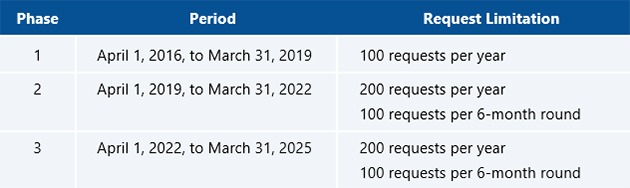
After more than six years of implementation, this program is considered successful and can be extended to support Japanese enterprises in establishing patent rights in Vietnam.

Effectiveness

This program has many advantages, such as:

  • Applications originating from Japan are usually of good quality with clear and coherent specification It is possible that the IP Office’s requirements for specifications are already very consistent with Japanese applicants’ way of drafting specifications thanks to the JPO’s training programs for the IP Office.
  • Patents in Japan usually have a short examination timeline and are granted very quickly, even within the application filing timeline in Vietnam (12 months from the priority date for applications filed under the Paris Convention and 31 months from the priority date for applications filed as PCT national phase applications).
  • The coordination between the JPO and the IP Office has been very good. PPH applications are processed in a quick and efficient manner.
  • Japanese applicants and their representatives also often coordinate well with the IP Office to rectify formality shortcomings and avoid prolongation of the examination period.

Although there are no official statistics from the IP Office, according to independent statistics for applications whose PPH requests were filed by Tilleke & Gibbins’ associate firm (one of the most prolific filers under the PPH), the examination period for applications under the PPH has been significantly shortened, compared to the period for substantive examination as prescribed by law (18 months):

  • The average period for receiving the first office action as from the date of the PPH request is 8.53 months.
  • The average period for receiving a notice of allowance without an office action from the date of requesting PPH is 7.98 months.

Further, the prescribed 18-month time limit for examination is often difficult to achieve for various reasons, and the actual examination period for applications not under the PPH program is typically much longer than 18 months in practice. Obviously, the PPH has been providing a tremendous time benefit to Japanese applicants.

Current Status

Since its inception, the PPH program has attracted the attention of many Japanese enterprises and industrial property representatives in Vietnam. In fact, in the first rounds of this program, the timeline for the number of requests to reach the limit was often very short, and in many cases the limit was reached on the very first day the round was opened.
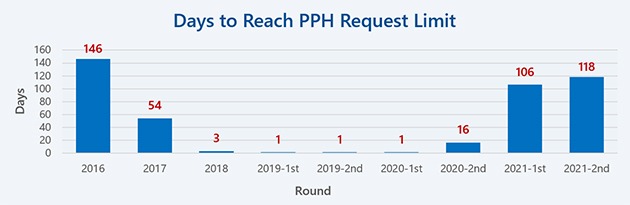
However, despite the PPH’s apparent effectiveness, recent monitoring of the number of applications as well as the time limit for filing PPH requests shows that this program has not been attracting the attention of Japanese applicants as much as before. According to the above figure, the number of days to reach the request limit has increased in every period since 2020. By 2022, the first round, which was opened on April 1, 2022, had not even reached 100 requests after six months, and the 34 remaining spots were moved to the second round, which was opened on October 1, 2022.

It is not clear why Japanese applicants have shown reduced interest in the PPH program after its initial popularity, though it is worth noting that the time period in which the number of PPH requests was slower to reach the limit (from October 2020 to mid-2022), coincided with the period when Japan and Vietnam were most affected by the Covid-19 pandemic. This may have affected the management strategy of Japanese enterprises as well as the budget for promoting IP portfolios.

Upcoming Changes

Article 114 of Vietnam’s amended IP Law, which took effect on January 1, 2023, allows the IP Office to use the results of substantive examination of a patent application claiming the same invention filed with a foreign patent office in the process of assessing the patentability of the corresponding Vietnamese application. The latest draft of a circular to replace Circular 01/2007, which guides the implementation of the IP Law, also includes provisions intended to allow an applicant to proactively request the IP Office to proceed in this manner. Also according to this draft circular, if the IP Office accepts the applicant’s request, a communication on substantive examination results must be issued for the Vietnamese application within 12 months from the date of the request.

As such, Article 114 of the IP Law seems to open a new door for patent applicants in accelerating the examination process in Vietnam. This program is expected to be equally effective and possibly even more effective than existing acceleration programs. The scope of expedited examination is extended to applicants from all countries and is not limited only to applications originating from Japan and South Korea (which has its own PPH with Vietnam) or applications with equivalent applications filed in ASEAN countries under the ASPEC program.

Although on the positive side, the expedited process will give applicants more options, on the other hand, because of the overlap in the results that can serve as basis for examination, this new program will “steal” applications from the PPH program. Thus, once the new program goes into effect, Japanese applicants will no longer have a significant advantage over applicants from other countries that can use foreign results. However, according to the statistics cited above, the average examination period of the PPH program may still be shorter, and the PPH program has been operating in a stable manner; hence, in the early period once the new program is in place, the Japan PPH may still be more attractive.

As Vietnam currently does not have a mechanism for extending the protection term of a patent, the early granting of a protection title is still an advantage. The PPH remains an effective channel for Japanese applicants in expediting the examination and granting of patents in Vietnam.

RELATED INSIGHTS​ 

October 24, 2025
Thailand currently lacks a specific franchise act. Consequently, the legality of any franchise agreement is determined by its compliance with various existing laws, such as the Civil and Commercial Code, the Trademark Act B.E. 2534 (1991) (as amended), and the Unfair Contract Terms Act B.E. 2530 (1997). Thailand is a freedom-to-contract jurisdiction. This allows for a high degree of flexibility and autonomy in contractual arrangements, provided that the terms do not violate any laws or public policy and do not fall under the scope of unfair contract terms. Given this, the requirement for fairness in franchise agreement terms often leads to uncertainty, but decisions from the Trade Competition Commission of Thailand (TCCT) can provide guidance on whether specific contentious terms are in fact fair.  One issue worth examining in this light is the inclusion of terms on nonrefundable franchise fees and strict purchasing conditions. Franchise Fee: Unfair to Refuse Refund? Nonrefundable franchise fees represent a significant upfront investment for franchisees, often becoming a point of contention if the franchise relationship deteriorates or the franchisor ceases operations. Their fairness and enforceability are frequently scrutinized by regulatory bodies like the TCCT, highlighting the critical balance between contractual freedom and franchisee protection. Faced with one such case, the TCCT considered whether it was unfair for the franchisor to refuse to refund the franchise fee after the franchisor ceased operations.  The franchisee had entered into a service agreement on August 2, 2021, and begun operating on October 9, 2021. However, by November 21, 2023, the franchisee was notified that the system would be shut down for maintenance, and by December 26, 2023, the franchisor announced the cessation of operations due to financial losses. The franchisee then requested a refund of the franchise fee. Unfortunately for the franchisee, the TCCT found that the franchisor’s
October 23, 2025
Myanmar’s customs authorities have introduced new procedures allowing copyright holders to protect their intellectual property from infringing goods at the border. The Ministry of Finance and Revenue issued Notification No. 107/2025 on September 11, 2025, establishing rules and requirements for customs recordation under the Copyright Law of 2019. The notification includes eight official forms for copyright-related customs matters—three for applicants and five for the Customs Department. This was followed by Customs Department Announcement No. 1/2025, dated September 29, 2025, which details the security required for suspended goods. Customs recordation provides a proactive mechanism for rights holders to prevent importation of pirated works. By registering their works with the Customs Department, rights holders gain access to enhanced border enforcement measures, empowering customs officials to identify and intercept pirated goods before they enter the market. While copyright protection in Myanmar arises automatically under the Copyright Law of 2019, a registration certificate for copyright or related rights is required to apply for customs recordation. Customs Recordation Registered copyright and related rights holders can apply directly or through authorized legal representatives for customs recordation to prevent cross-border trade in pirated works. Applications must use the prescribed form and include all supporting documentary evidence specified in the form. The Customs Department will notify applicants within 15 days of receiving their application. Each recordation remains valid for two years from the date of acceptance and may be renewed for successive two-year periods by submitting a renewal application at least 30 days before expiration. Rights holders whose works are recorded must notify the Customs Department within five days of any amendment or withdrawal of information at the Intellectual Property Department. Suspension Orders Registered copyright and related rights holders can request a suspension order to prevent release of pirated goods into free circulation, regardless of whether they
October 3, 2025
In Thailand, the rise in online intellectual property infringement has prompted authorities to strengthen enforcement efforts, including the use of website-blocking orders under Section 20(3) of the Computer Crime Act B.E. 2560 (2017) (CCA). This provision authorizes the Ministry of Digital Economy and Society (MDES), with court approval, to block or remove computer data that constitutes a criminal offence under IP law. Since its implementation, the procedure has undergone several developments, which is an encouraging sign of progress. Website-blocking procedure In practice, website-blocking orders under Section 20(3) of the CCA are primarily used for copyright and trademark infringement. While such orders are legally applicable to patent infringement, their use remains challenging due to the difficulty of proving infringement through administrative procedures. The website-blocking procedure begins when an IP owner identifies online infringing content. For copyright infringement, which is considered a compoundable offence, the IP owner is required to first file a police report with the specialized police unit known as the Economic Crime Suppression Division (ECD) prior to filing the website-blocking application with the Department of Intellectual Property (DIP). For trademark infringement cases, the application can be filed directly with the DIP without a prior police report. The DIP reviews the evidence and, if infringement is confirmed, forwards it to the MDES for further consideration. If the case is deemed valid, the MDES requests a court order to block the infringing website. Once granted, the MDES notifies the internet service providers (ISPs) to block access to the specified website. Website blocking procedure in Thailand Recent advancements in website-blocking actions Seamless collaboration through digital integration. Thailand has made significant progress in digitizing its website-blocking procedures to improve efficiency and transparency. At present, all website-blocking applications and supporting evidence must be submitted in electronic format. These systems have significantly reduced processing
September 24, 2025
Online shopping in Thailand is more accessible than ever, with global platforms, local social media shops, and entertainment-driven social commerce enabling instant purchases. However, this convenience comes with rising concerns over digital intellectual property (IP) infringement, including counterfeit goods, pirated content, and unauthorized brand usage. At first glance, online platforms appear to offer quick solutions. Most major e-commerce sites, social media channels, and social commerce platforms provide “notice and takedown” systems, where IP owners can file complaints and request the removal of listings that infringe IP rights, such as trademarks and copyrights. These tools are certainly useful, as seeing a fake product vanish from a platform feels like progress. But the reality is less reassuring. The counterfeit goods themselves remain in warehouses, markets, or shops, ready to be resold. Sellers whose accounts are taken down often return within days under new names or accounts. In other words, a takedown is like cutting weeds without pulling out the roots: they always grow back. While notice and takedown tools are widely available and can be managed internally by most IP owners, their impact is often short-lived. IP owners seeking more effective, lasting protection need to take a more strategic and multilayered approach. The same applies to online piracy. Unauthorized streaming websites that offer free access to movies, TV shows, or sports broadcasts have become widespread in Thailand. To combat this, rightsholders can request website blocking under the Computer Crime Act, through the Ministry of Digital Economy and Society and the courts. Once requests are approved, internet service providers are ordered to block access to infringing sites. Blocking orders can be effective in disrupting large-scale piracy operations, but they also face limitations—pirate sites frequently reappear under new domains. Strategic Protection Whether the infringing material is physical counterfeit goods or intangible streaming content,