
You are using an outdated browser and your browsing experience will not be optimal. Please update to the latest version of Microsoft Edge, Google Chrome or Mozilla Firefox. Install Microsoft Edge

March 12, 2025

Updates on Thailand’s Film Incentive Measures

In November 2024, Thai Prime Minister Paethongtarn Shinawatra unveiled ambitious plans to enhance tax incentives for foreign film productions during a networking reception in Los Angeles, coinciding with her visit to the APEC Economic Leaders’ Meeting in Lima, Peru. This event, attended by Motion Picture Association executives and leaders from top US film companies, marked a significant commitment to boosting foreign investment in Thailand’s film industry.

Thailand’s Department of Tourism (DOT) prioritized the initiative by updating the Announcement on Guidelines, Procedures, and Conditions for Applying for Benefits Under the Incentive Measures for Foreign Film Production in Thailand in December 2024 to further position Thailand as a destination for large-scale international film and television productions.

Key Amendments to Film Incentives under the 2024 Announcement

The 2024 announcement introduced major changes, including (1) removal of the rebate cap, previously set at THB 150 million (approx. USD 4.5 million) per project, enabling rebates based on total qualified spending, and (2) an increase in cash rebate rates. The maximum allowable cash rebate rate was increased to 30 percent from the previous cap of 20 percent. The base rate of 15 percent remains unchanged.

The primary incentive available under the 2024 announcement is a 15 percent cash rebate on qualified spending in Thailand of at least THB 50 million (approx. USD 1.5 million).

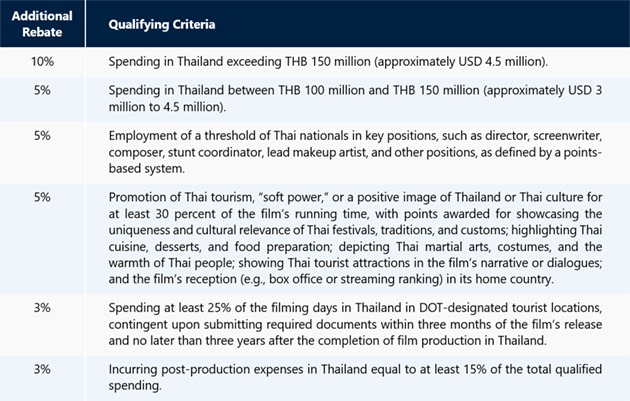
On top of this primary incentive, additional incentives are available; however, the total possible cash rebate is capped at 30 percent, and the additional incentives can only amount to an added 15 percent. Also, the total rebate (including both primary and additional incentives) for films with a budget of less than THB 100 million (approx. USD 3 million) is capped at 25%.

To obtain a higher rebate rate, productions may apply for the following additional incentives:
Compliance Requirements

Foreign production companies seeking to benefit from Thailand’s enhanced film incentives must navigate a structured application and compliance process. The 2024 announcement establishes different processing periods for applications based on spending thresholds. Noncompliance with these procedural requirements could jeopardize eligibility for the rebates, regardless of the actual amount spent in the country.

One of the key criteria for receiving the incentives is that the filming must not cause or result in environmental damage or harm to natural resources; otherwise, the approved incentives will be revoked.

The timing of this policy is noteworthy, given the recent decision regarding an environmental dispute in which Thailand’s Ministry of Natural Resources and Environment sued a major production company for over THB 100 million (approx. USD 3 million), alleging ecological damage caused during filming. The lawsuit claimed that alterations to a bay landscape and failure to comply with legal requirements and agreements established with the authorities resulted in extensive environmental harm, including deforestation and coral reef destruction. After 20 years of legal proceedings, the Thai Supreme Court ruled in 2022 that the production company must pay THB 10 million (approx. USD 300,000), or 10% of the original claim. This case underscores the risk of noncompliance with legal requirements, which can result in negative publicity, financial liability, and the loss of eligibility for incentives.

Tax Implications and Documentation Requirements

The rebate mechanism interacts with several Thai tax considerations that foreign production companies should carefully evaluate. The 2024 announcement specifies that the rebate itself is subject to 1% withholding tax under the Thai Revenue Code. Additionally, service and rental expenses paid to Thai providers typically attract withholding tax rates of 3% and 5%, respectively, while most goods and services in Thailand are subject to 7% VAT (value-added tax), significantly impacting overall production budgeting. The rebate application process also requires comprehensive financial documentation as specified in the requisition form, with all expenses requiring proper verification according to Thai Revenue Department standards.

Understanding which preproduction, production, and postproduction expenses qualify (particularly the requirement that physical production expenses in Thailand must be at least 50% of total qualified spending) requires careful planning. Professional tax and legal advice can help companies optimize their structure to maximize eligible expenses while ensuring regulatory compliance.

Final Remarks

Thailand’s revised film incentives under the DOT’s 2024 announcement provide lucrative opportunities for foreign film and television productions. By enhancing financial incentives, Thailand aims to attract more international projects, thereby stimulating economic growth and promoting cultural exchange. As the global film industry continues to evolve, Thailand’s proactive approach positions it as a competitive and attractive destination for filmmakers worldwide. Productions planning to capitalize on these incentives are advised to consult local experts to navigate the regulatory landscape effectively.


RELATED INSIGHTS​ 

August 6, 2026
Every month, VAT-registered businesses in Thailand calculate their output and input VAT and file a return to pay the net amount due or claim a refund. Yet a common and costly dispute arises when a business that has paid input VAT to its supplier—and done everything asked of it—later finds that input VAT rejected on the grounds that the tax invoice was issued by “a person not entitled to issue tax invoices.” In these cases, a buyer may have confirmed the supplier’s VAT registration on the Revenue Department’s website, paid through the banking system, received a complete tax invoice, and kept full payment and inventory records. Even so, if the Revenue Department later determines that the supplier did not genuinely make the sale or collected the VAT without remitting it, the department can disallow the input VAT and assess additional tax, surcharge, and penalty—often more than a year after the transaction. A new article from tax and dispute resolution specialists at Tilleke & Gibbins in Bangkok examines how the Revenue Department and the courts approach these disputes, including two recent Supreme Court (Tax Division) decisions confirming that the taxpayer bears the burden of proving a supplier genuinely sold and delivered the goods and received payment. It considers why the VAT registration system offers no legal safe harbor, why the evidentiary burden falls hardest on online and cross-border transactions where buyers and sellers never meet, and how the Revenue Department’s own digital infrastructure could detect non-remitting suppliers at the source rather than shifting the loss to good-faith buyers. The article also sets out practical guidance: how to build a comprehensive “know-your-supplier” file at the time of a transaction, the procedural steps and strict deadlines for challenging a VAT assessment, and why dispute readiness belongs alongside tax planning at the center
August 4, 2026
Intellectual property (IP) protection sometimes hinges on fame and recognition. However, this alone will not always be sufficient to overcome an IP dispute when it involves contractual obligations or registered rights. Below are five cases from around the world that tackle some of the basic issues in IP registration, ownership, commercialization, and enforcement. 1. USA: Taylor Swift Trademark Application Refused Taylor Swift recently filed a trademark application to register “The Life of a Showgirl,” which is the title of her 12th studio album. When examining a trademark application, the examiner considers various factors before deciding whether it should be registered. One of these factors is whether there is a likelihood of confusion (i.e., would a regular consumer mistake the origin of the trademark). In Taylor Swift’s case, the US Patent and Trademark Office (USPTO) decided that that there would be a risk of confusion. This decision was based on the existing registered trademark, “Confessions of a Showgirl,” owned by Maren Wade, which was registered in 2015. The USPTO refused Taylor Swift’s application based on the shared key distinctive element “of a showgirl,” the lack of sufficient distinguishing terms, the marks being used in overlapping markets (entertainment and performances), and because consumers may assume a common commercial source. Maren Wade then filed a lawsuit in California against Taylor Swift and her affiliated companies, arguing that Taylor Swfit’s branding is confusingly similar in structure, wording, and overall commercial impression to her registered mark. She is also drawing on the USPTO’s refusal of Taylor Swift’s application to support her argument of a likelihood of confusion. A judgment has not yet been reached in this case, but it serves as an important reminder of the importance of satisfying the essential elements required for IP registration. 2. Australia: Katy Perry v. Katie Perry In
July 27, 2026
Vietnam’s new E-Commerce Law, which took effect on 1 July 2026 along with its implementing Decree No. 248/2026/ND-CP (Decree 248), marks a significant development in the country’s approach to online intellectual property (IP) enforcement, reflecting a clear shift from a reactive model of intermediary liability to one that expects platforms to play a more active role in preventing infringement. From notice-and-takedown to platform responsibility The most significant change introduced by the E-Commerce Law is the transformation of the legal role of e-commerce platforms. The existing safe harbor provisions under the IP Law and the copyright notice-and-takedown regime established by Decree 17/2023/ND-CP (Decree 17) largely required intermediaries to act only after receiving notice of infringement. Once infringing content had been removed, the platform’s legal obligation was generally considered fulfilled. The new legislation adopts a fundamentally different approach. Article 17 of the E-Commerce Law requires intermediary platforms to screen information relating to goods and services before publication in order to prevent listings involving counterfeit or IP-infringing goods, and goods of unknown origin. Rather than relying exclusively on complaints from rights holders, platforms are now expected to implement preventive measures before infringing listings become publicly available. Decree 248 further requires platforms to update keyword filters based on recommendations issued by competent authorities. These filtering mechanisms are intended to prevent prohibited listings from appearing on the platform and represent a further move away from a purely complaint-driven enforcement model. The legislation also introduces Vietnam’s first statutory stay-down obligation. Under the E-Commerce Law and Decree 248, major digital platforms must maintain automated systems capable of reviewing, warning against, and removing unlawful listings while also implementing measures to prevent repeat violations, defined under Decree 248 as conduct that has previously been identified and handled by the platform, but continues to recur. This obligation addresses one
July 27, 2026
Tilleke & Gibbins’ intellectual property specialists have authored the Thailand chapter of Trade Secrets 2026 from Chambers and Partners. This global guide examines the legal frameworks governing trade secret protection, enforcement, and litigation across jurisdictions worldwide. The Thailand chapter provides a comprehensive overview of the country’s legal regime for protecting confidential business information, covering the legal framework, trade secret misappropriation, litigation procedures, remedies, and dispute resolution. Some topics covered include: Protectable trade secrets Reasonable measures to maintain secrecy Employee confidentiality Trade secret licensing Civil and criminal remedies Litigation procedures and injunctions Damages and other remedies Mediation and arbitration The guide also examines practical issues relating to safeguarding trade secrets, defending against allegations of misappropriation, and managing trade secret disputes in Thailand. Chambers and Partners’ Global Practice Guides provide in-house counsel with authoritative commentary on practical legal issues affecting business, enabling readers to compare legislation and procedures across multiple jurisdictions. The Thailand chapter of Trade Secrets 2026 is available on the Chambers and Partners website.