You are using an outdated browser and your browsing experience will not be optimal. Please update to the latest version of Microsoft Edge, Google Chrome or Mozilla Firefox. Install Microsoft Edge

October 21, 2024

Thai Court Decision Moves Design Assessment Closer to International Standards

Managing Intellectual Property

Thailand’s Central Intellectual Property and International Trade (IP&IT) Court has delivered a favorable ruling for Sumitomo Rubber Industries, Ltd., a major player in the tire manufacturing industry, regarding the registration of its motorcycle tire design patent. In this case, Tilleke & Gibbins represented Sumitomo in successfully advocating for recognition of the unique design elements in the company’s motorcycle tire products.

Case Overview

The case revolved around Sumitomo’s two design patent applications for motorcycle tire designs, which were initially rejected by the Department of Intellectual Property (DIP) on the grounds that they were similar to prior art. Based on an examination of the design elements, primarily focusing on the tire tread patterns, the DIP’s Patent Board had concluded that Sumitomo’s designs were not sufficiently unique to warrant patent protection, as the tread patterns of the new designs were deemed too similar to one found in prior art for tire products.

In response, Tilleke & Gibbins filed a complaint with the IP&IT Court on behalf of Sumitomo, seeking a revocation of the Patent Board’s decision and requesting that the court compel the DIP, as the defendant, to proceed with the registration of Sumitomo’s design patents. The complaint emphasized that the designs were novel and distinct, warranting patent protection under Thai law.

Legal Strategy

The firm’s legal argument focused on the interpretation of Thai patent law, particularly regarding the protection of a product’s external appearance, and emphasized that the determination of a design’s novelty must consider the product’s overall appearance rather than isolating individual features. This approach is consistent with international guidelines on design patents, which require the evaluation of novelty and distinctiveness based on how an informed user would perceive the design as a whole.

While Sumitomo’s tire tread patterns may share some superficial similarities to existing designs, the overall impression of the designs was unique. The grooves in the tread of Sumitomo’s design were arranged diagonally—with sharp, narrow ends—and extended fully to the tire edge, features absent in existing designs. These unique elements contributed to a distinctive appearance that set Sumitomo’s designs apart.

During the trial, Tilleke & Gibbins provided detailed technical testimony regarding the design features, aiming to show how the design’s unique diagonal grooves and sharp, pointed ends made it look noticeably different from the more rounded and thicker lines in the existing designs. This testimony was essential in convincing the IP&IT Court that the designs were novel and deserved patent protection under Thai law.

Court Ruling

The IP&IT Court issued a favorable ruling revoking the DIP’s rejection of Sumitomo’s design patent applications. In its judgment, the IP&IT Court considered the definition of “product design” under the Patent Act B.E. 2522 (1979), which refers to the shape, pattern, or color of the product having special characteristics that make it suitable as a model for industrial products. Therefore, product design patents protect the external appearance of products, including their shape, pattern, and color. When assessing whether a product design is similar to an existing design, only the product’s external appearance should be compared. This principle further supported the court’s ruling that Sumitomo’s designs were distinct and deserving of patent protection.

The IP&IT Court further agreed with the argument that the DIP had failed to assess the overall appearance of the tire designs properly. The IP&IT Court emphasized that a design patent protects a product’s external appearance and identified some critical differences between Sumitomo’s designs and the prior art. For instance:

  • The groove patterns in Sumitomo’s designs were narrower and sharper, with the grooves extending fully to the tire edges, while the grooves in the existing designs were thicker and more rounded and did not reach the tire edges.
  • The side pattern of Sumitomo’s tires, which featured alternating short and long diagonal grooves, was a feature absent in the existing designs.

The court’s consideration and thoughtfulness aligned with the diagram the firm presented to the court during the trial.
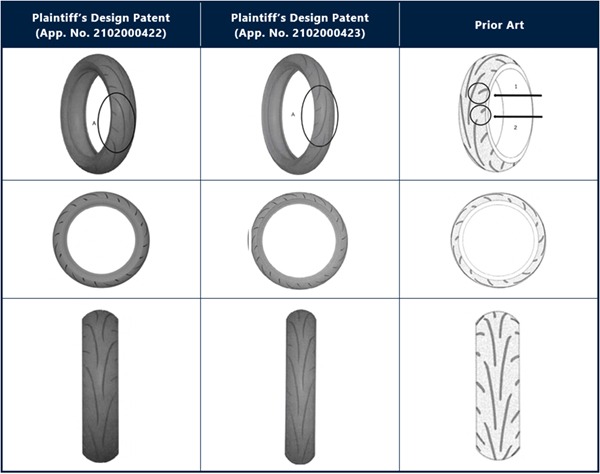
Based on these considerations, the IP&IT Court ruled that Sumitomo’s tire designs were indeed novel and not mere imitations of the prior art. As a result, the IP&IT Court ordered the DIP to proceed with the registration of Sumitomo’s design patents.

Key Takeaways

The IP&IT Court judgment emphasized the need to assess the overall appearance of a design when determining its eligibility for patent protection, aligning Thai law with international standards. The judgment clarifies that even functional products, like tire tread patterns, can have distinctive design features worthy of patent protection.

The favorable decision in Sumitomo’s motorcycle tire case is a significant win and demonstrates the importance of a legal strategy that considers both the technical and visual aspects of product design.

This article first appeared in Managing Intellectual Property.

RELATED INSIGHTS​ 

July 21, 2026
On July 6, 2026, Myanmar’s Ministry of Finance and Revenue introduced revised procedures governing the importation and exportation of goods and vehicles, replacing the framework that had been in place since 2017. The revised procedures were introduced in Notification No. 115/2026, which establishes updated compliance requirements and penalties for importers and exporters, covering licensing, declarations, product specifications, prior arrival of goods, and imports or exports made without the required licenses or permits. Scope Unlike its predecessor (Notification No. 6/2017), which focused primarily on import-related noncompliance, the new notification regulates both import and export activities and introduces a separate penalty schedule for export violations. Exporters are now required to ensure that their exports comply with the approvals stated in export licenses and permits, match the information declared in export declarations, and are supported by the required licenses, permits, and accompanying documents. Import Compliance and Penalties The new notification imposes several compliance requirements on importers. Importers must ensure that the country of origin, branding, labeling, and other product information are consistent with the relevant import license or permit, import declaration, and the imported goods. For vehicles and machinery, the model year must match the year approved by the Ministry of Commerce. Importers must also ensure that goods are not imported before the issuance or after the expiry of the import license or permit, and that the imported quantity does not exceed the approved amount. Failure to comply with these requirements may result in regulatory action. As for the notification’s revised penalties for noncompliance with import licensing requirements, imports made without the required import license, permit, or import declaration may be subject to fines ranging from one to three times the assessable value (AV) of the goods, depending on the category of goods involved. Certain vehicles and machinery, as well as specific
June 29, 2026
Thailand’s cabinet has approved the draft Act on Liability for Defective Goods, commonly called Thailand’s “Lemon Law.” The Draft Act is currently pending consideration by Parliament. The draft law aims to strengthen buyers’ position in pursuing cases against sellers. While the Civil and Commercial Code offers provisions governing liability for defective goods, it is difficult in practice for buyers to successfully make a claim against sellers, particularly where defects are latent and not discoverable at the time of sale or delivery. By introducing product-specific rules and clearer remedies, the new law is intended to modernize Thailand’s consumer protection framework and align it more closely with international standards, and to help relieve the buyer’s burden of proof against the seller in product liability cases. If enacted, the draft act will take effect 180 days after publication in the Government Gazette, giving businesses a transition period to assess their compliance obligations. This article provides an overview of the key provisions of the draft act and highlights some practical considerations for businesses operating in Thailand. Scope and Key Definitions The draft act applies to sellers—defined as persons who sell goods in the ordinary course of business—and protects buyers, a term defined broadly to include not just the original purchaser but also transferees and successors in title. This expands the class of people who can bring claims. The law does not apply to used goods, live animals, or goods exempted by future ministerial regulation. It also leaves intact any separate warranties, promises, advertisements, or other guarantees a seller has given; those remain enforceable alongside the new statutory rights. General Liability for Defective Goods Sellers are liable for defects that exist at the time of delivery, regardless of whether the seller knew about them. Liability arises where a defect reduces: The benefit intended under
June 23, 2026
On May 26, 2026, Thailand’s Department of Land Transport (DLT) published for public consultation a draft amendment to the Ministerial Regulation on Electronic Ride-Hailing Vehicles that would, for the first time, allow juristic persons (legal entities) to register vehicles as electronic ride-hailing cars—a right that currently belongs exclusively to natural persons, limited to one person per one vehicle. If finalized in its current form, the regulation would significantly expand the supply side of Thailand’s ride-hailing market by enabling corporate fleet operators to enter the space. The public comment period is open through June 24, 2026. Key Principles Under the Draft Regulation Under the proposed amendment, juristic persons that maintain a fleet of at least 50 vehicles will be permitted to register vehicles as electronic ride-hailing cars. This represents a fundamental shift from the current framework, which restricts registration to individual natural persons on a one-person-one-car basis. Vehicle Specifications Corporate-owned ride-hailing vehicles must meet the following requirements: Be brand new from the factory, or no more than two years old from first registration with no more than 20,000 km of use. Not be a vehicle that has been reconstructed or repaired after involvement in a serious accident affecting safety—a standard consistent with public transport vehicles (RorYor. 6). Be classified as small, medium, or large in accordance with ministerial or director-general specifications. The vehicles may be equipped with safety devices such as interior or exterior cameras (video/photo recording) and can retain the original factory color of the vehicle body (no mandatory color change is required). License Plates Corporate ride-hailing vehicles will use license plates of the same size, characteristics, and color as those for private passenger vehicles not exceeding seven seats (RorYor. 1), rather than public transport plates. Potential Impact The government has stated that the regulation is intended to: Promote
May 13, 2026
Thailand has prescribed more stringent labeling specifications for traditional and electric vehicles (EVs), requiring manufacturers and importers for sale to display clear, accurate product information on vehicle labels. The requirements, which took effect on March 21, 2026, are set out in a notification issued under Thailand’s consumer protection framework. Background and Scope Under Thailand’s Consumer Protection Act (CPA), products manufactured for sale or imported into Thailand must generally comply with the CPA’s broad labeling requirements, unless the Label Committee prescribes more specific and stringent requirements for certain products. Accordingly, prior to the issuance of this notification, traditional autos and EVs were subject only to the general labeling requirements. Following the issuance of this Label Committee notification, traditional autos and EVs are now for the first time specifically subject to a dedicated regulatory framework for labeling. The requirements apply to private passenger vehicles and private trucks that have not yet been registered, including those powered by an internal combustion engine, electric power, or a combination of both. Label Requirements Labels must be displayed in Thai or with a Thai translation, and must be clearly visible and legible. Text must be proportional to the label area, with a minimum character height of 2 millimeters. All covered vehicles must display the following: Product name, trade name, or trademark Brand and model Manufacturer or importer information Size, weight, and load-bearing capacity Warranty conditions Drive system, usage instructions, and safety precautions Manufacturing date Price Additional Requirements for EVs EVs must also display the following: Type of electric vehicle (e.g., HEV, PHEV, BEV, or FCEV) Maximum electric motor power and rated continuous output power Battery type and capacity Battery warranty conditions or a clear statement that no warranty is provided Estimated driving range per full battery charge Electrical system safety standard Electricity consumption rate These