You are using an outdated browser and your browsing experience will not be optimal. Please update to the latest version of Microsoft Edge, Google Chrome or Mozilla Firefox. Install Microsoft Edge

December 8, 2023

Thailand Extends Payment Deadline for 2024 Land and Building Tax

Thailand’s Ministry of Interior has extended the deadlines for payment of the 2024 land and building tax and related procedures by two months. The announcement was published in the Government Gazette on November 30, 2023.

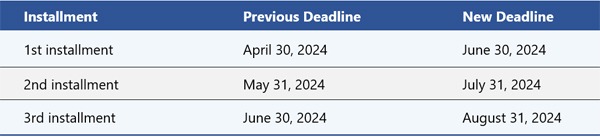
According to the new timeline in the ministry’s announcement, the official land and building tax assessment forms will be sent to taxpayers by the end of April 2024 (extended from February 2024) while the deadline for payment of land and building tax has been extended to June 30, 2024 (from April 30, 2024).

For payments made in installments, the announcement also extended the deadline for each installment as follows:

For more details on these measures, or any aspect of Thailand’s land and building tax, please contact Chaiwat Keratisuthisathorn at [email protected] or Supranee Arjjit at [email protected].

RELATED INSIGHTS​ 

August 6, 2026
Every month, VAT-registered businesses in Thailand calculate their output and input VAT and file a return to pay the net amount due or claim a refund. Yet a common and costly dispute arises when a business that has paid input VAT to its supplier—and done everything asked of it—later finds that input VAT rejected on the grounds that the tax invoice was issued by “a person not entitled to issue tax invoices.” In these cases, a buyer may have confirmed the supplier’s VAT registration on the Revenue Department’s website, paid through the banking system, received a complete tax invoice, and kept full payment and inventory records. Even so, if the Revenue Department later determines that the supplier did not genuinely make the sale or collected the VAT without remitting it, the department can disallow the input VAT and assess additional tax, surcharge, and penalty—often more than a year after the transaction. A new article from tax and dispute resolution specialists at Tilleke & Gibbins in Bangkok examines how the Revenue Department and the courts approach these disputes, including two recent Supreme Court (Tax Division) decisions confirming that the taxpayer bears the burden of proving a supplier genuinely sold and delivered the goods and received payment. It considers why the VAT registration system offers no legal safe harbor, why the evidentiary burden falls hardest on online and cross-border transactions where buyers and sellers never meet, and how the Revenue Department’s own digital infrastructure could detect non-remitting suppliers at the source rather than shifting the loss to good-faith buyers. The article also sets out practical guidance: how to build a comprehensive “know-your-supplier” file at the time of a transaction, the procedural steps and strict deadlines for challenging a VAT assessment, and why dispute readiness belongs alongside tax planning at the center
July 3, 2026
Thailand will keep its reduced government fees for property sale and mortgage registration in place for another year. Two Ministry of Interior notifications, issued following a cabinet resolution on June 30, 2026, and published in the Government Gazette on July 1, 2026, extend the previously reduced fee levels through June 30, 2027. The reduced registration fees apply to the sale and mortgage of the same property types covered in prior versions of the scheme: detached houses, semidetached houses, row houses, commercial buildings, land transferred together with such buildings, and condominium units. To be eligible for the reduced fees, the purchase price, the officially assessed value, and the mortgage amount must each not exceed THB 7 million, and the buyer must be a Thai individual. The reduced registration fees for eligible sales and mortgages are calculated as follows: Sale: 0.01% of the official assessed value (reduced from standard rate of 2%) Mortgage: 0.01% of the mortgage amount (reduced from standard rate of 1%) The reduced mortgage registration fee applies only if the mortgage is registered at the same time as the sale of the property.
April 30, 2026
Thailand’s Long-Term Resident (LTR) Visa regime offers an attractive immigration pathway for qualifying foreign nationals, providing a 10-year renewable permission to stay in Thailand. Following amendments under Board of Investment (BOI) Announcement No. Por. 3/2568 dated February 4, 2025, the regime now more explicitly accommodates property investment as a qualifying vehicle—a development of particular relevance to foreign nationals already considering real estate acquisitions in Thailand. The LTR Visa is available to several categories of applicants, including wealthy global citizens with global assets of at least USD 1 million, and wealthy pensioners aged 50 or older with an annual pension or fixed income of at least USD 40,000. Property as a Qualifying Investment For both categories, property investment is recognized as one of three eligible investment types alongside Thai government bonds (with at least five years remaining to maturity) and direct investments in Thai companies or approved venture capital or private equity vehicles. The minimum qualifying property investment is USD 500,000 for wealthy global citizens and USD 250,000 for wealthy pensioners. Eligible property types include freehold condominiums, buildings, or villas, as well as leasehold properties with a remaining lease term of at least 10 years. Health Coverage Requirement Beyond the investment threshold, applicants must demonstrate adequate health coverage. This requirement can be satisfied through a health insurance policy covering at least USD 50,000 in Thai medical expenses with at least 10 months of remaining coverage, evidence of social security benefits covering Thai medical costs, or a bank deposit of at least USD 100,000 retained for 12 months. Practical Considerations For foreign nationals already considering property acquisitions in prime residential markets—where investment values commonly meet or exceed the USD 500,000 threshold—the visa pathway effectively transforms a real estate purchase into a dual-purpose investment, combining asset ownership with long-term residence rights that

April 7, 2026
Real estate law specialists from Tilleke & Gibbins provided the chapter on Vietnam for Practical Law’s Commercial Real Estate Global Guide 2026, a comparative jurisdictional guide in Q&A format giving a high-level overview of real estate investment structures, restrictions on foreign ownership, and other important issues of real estate law. The main topics include the following: Real estate investment Title to real estate Sale of real estate Real estate tax Real estate finance Real estate leases Planning and development controls To read the Vietnam chapter, please visit the Practical Law website and enroll in the free Practical Law trial to gain full access.