You are using an outdated browser and your browsing experience will not be optimal. Please update to the latest version of Microsoft Edge, Google Chrome or Mozilla Firefox. Install Microsoft Edge

September 7, 2021

Legal Options in Thailand When a Debtor Can’t (or Won’t) Pay Up

COVID-19 and the resulting lockdown measures to limit outbreaks in Thailand have caused significant financial difficulties for many business operators, large and small. Whether a business is a creditor or debtor, there is a high likelihood they have faced or will face a default caused by the pandemic. This article identifies three legal options available when a party defaults—civil cases, bankruptcy actions, and business rehabilitation actions—and compares key elements associated with each option. For context, those three options are defined as follows:

  • Civil case. A legal proceeding in which a creditor files a civil lawsuit (or arbitration claim) against a debtor for debt collection. If a debtor fails to settle a debt in accordance with a judgment, the creditor can ask the court to enforce the judgment by seizure and sale of the debtor’s assets through public auction.
  • Bankruptcy action. A legal proceeding under the Bankruptcy Act in which a government authority can collect a debtor’s assets, sell the assets by public auction, and distribute the net proceeds among creditors. In bankruptcy proceedings, the creditors will receive repayment in proportion to the size of the outstanding debts.
  • Business rehabilitation action. A legal proceeding under the Bankruptcy Act aimed at helping a debtor recover from insolvency and continue its business. Debtors are given debt relief and a “new start” through business rehabilitation, while creditors are able to collect a higher percentage of outstanding debt under rehabilitation than they would under a bankruptcy action.

In short, a civil case is a claim in court for repayment of a specific debt, a bankruptcy action results in distribution of the debtor’s assets among the creditors, and a business rehabilitation action aims to enable the debtor to stay in business while repaying their debts to some degree.

A civil case may be appropriate when the debtor defaults on debt repayment and is indebted to only the creditor bringing the action. A bankruptcy action should be considered when the debtor’s liabilities are greater than its assets, and its business cannot continue. Business rehabilitation may be a good option when there is still a reasonable chance of reforming and rebuilding the debtor’s business. The three options also differ in a number of other ways, as laid out below.


Legal Particulars
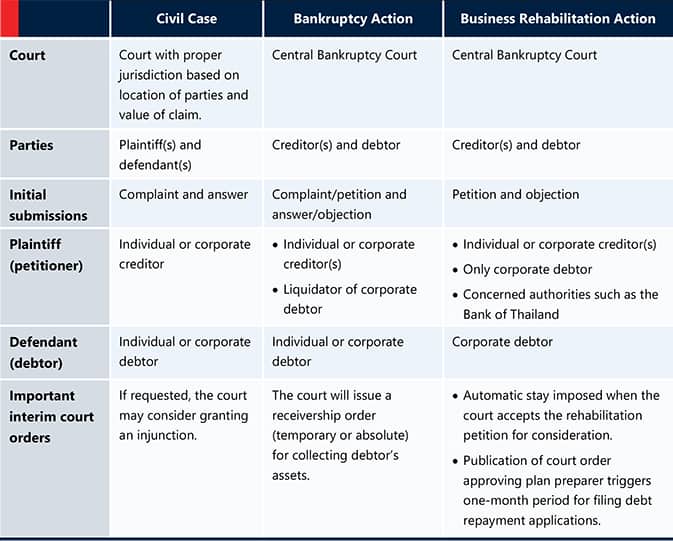
 

Requirements for Initiating Action
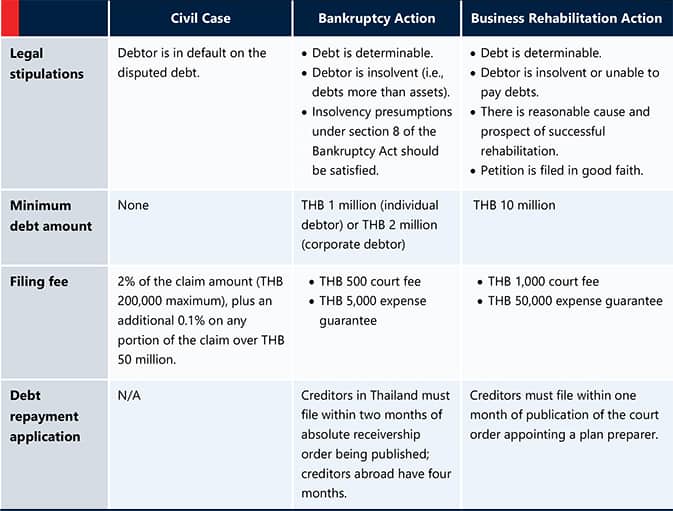
 

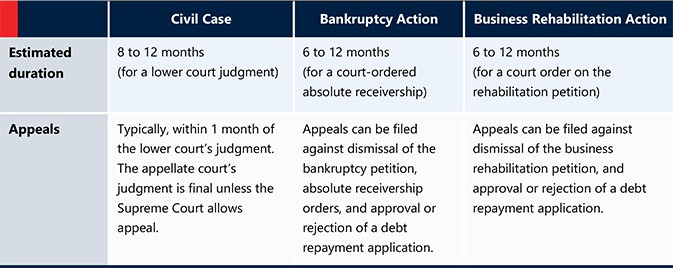
Proceedings
 

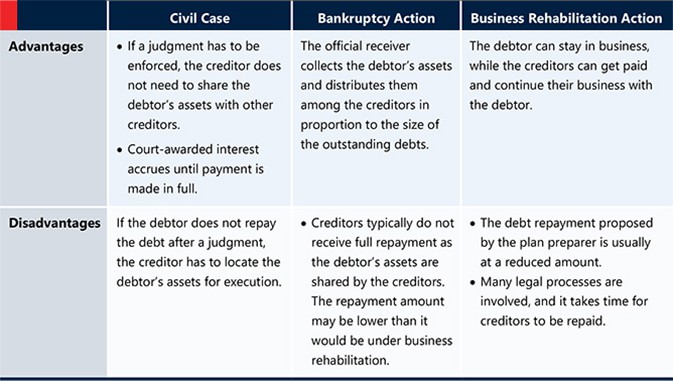
Advantages and Disadvantages
 

Conclusion

An essential step in pursuing any of these actions is retaining experienced local counsel who can offer tailored advice. Creditors should consider which of these three legal actions in Thailand best suits their needs and circumstances, and chart their course with the help of their legal advisor in Thailand. As noted above, a civil case might be the right option for a single creditor pursuing repayment, while bankruptcy actions and business rehabilitation are more far-reaching options that may be appropriate when there are serious underlying financial or structural issues affecting the debtor. With the aid of a specialist in debt recovery, bankruptcy, and business rehabilitation in Thailand, the creditor can consider the specific circumstances, lay out and execute a winning strategy, and resolve their debt recovery problems efficiently and cost-effectively.


RELATED INSIGHTS​ 

August 11, 2026
Cambodia’s Ministry of Justice has launched a new platform on its official website to publish notices of forced sales issued by each municipal and provincial court of first instance. The platform’s stated purpose is to inform the public and facilitate greater participation in forced-sale auctions conducted in connection with court-ordered enforcement proceedings. How the Platform Works The platform publishes forced-sale notices from courts of first instance across Cambodia’s municipalities and provinces and includes a link where the public can view properties currently subject to forced sale. To participate in a forced-sale auction, individuals can download Khmer-language bidding application forms through links provided on the platform. The form typically requires the applicant’s name, sex, year of birth, identity card number and issue date, and address, together with details identifying the immovable property (including its ownership certificate number), the relevant enforcement case number and date, and the reference to the public auction or tender announcement issued by the court. Completed application forms must be submitted directly to the specific municipal or provincial court that issued the forced sale. For further inquiries about a particular forced sale, interested parties should likewise contact the relevant municipal or provincial court. Forced Sale of Immovable Property in Cambodia The publication of these notices relates to the forced sale procedure for immovable property under Cambodia’s Code of Civil Procedure (CPC). Unlike property seizure by a court, a forced sale is a compulsory execution proceeding—a subsequent enforcement step that arises only after an underlying dispute has been adjudicated and a debtor fails to pay the debt or outstanding amount due under a final and binding judgment or other enforceable title of execution. For the purposes of this procedure, the term “immovable property” under the CPC refers to land, registered buildings, jointly held shares of such property, registered
August 6, 2026
Every month, VAT-registered businesses in Thailand calculate their output and input VAT and file a return to pay the net amount due or claim a refund. Yet a common and costly dispute arises when a business that has paid input VAT to its supplier—and done everything asked of it—later finds that input VAT rejected on the grounds that the tax invoice was issued by “a person not entitled to issue tax invoices.” In these cases, a buyer may have confirmed the supplier’s VAT registration on the Revenue Department’s website, paid through the banking system, received a complete tax invoice, and kept full payment and inventory records. Even so, if the Revenue Department later determines that the supplier did not genuinely make the sale or collected the VAT without remitting it, the department can disallow the input VAT and assess additional tax, surcharge, and penalty—often more than a year after the transaction. A new article from tax and dispute resolution specialists at Tilleke & Gibbins in Bangkok examines how the Revenue Department and the courts approach these disputes, including two recent Supreme Court (Tax Division) decisions confirming that the taxpayer bears the burden of proving a supplier genuinely sold and delivered the goods and received payment. It considers why the VAT registration system offers no legal safe harbor, why the evidentiary burden falls hardest on online and cross-border transactions where buyers and sellers never meet, and how the Revenue Department’s own digital infrastructure could detect non-remitting suppliers at the source rather than shifting the loss to good-faith buyers. The article also sets out practical guidance: how to build a comprehensive “know-your-supplier” file at the time of a transaction, the procedural steps and strict deadlines for challenging a VAT assessment, and why dispute readiness belongs alongside tax planning at the center
July 15, 2026
On July 8, 2026, Thailand enacted a new law significantly expanding the framework for government service delivery and licensing facilitation. The Facilitation of Licensing and Public Services Consideration Act B.E. 2569 (2026) (Facilitation Act 2026) replaces and expands the framework of governmental services under the Facilitation of Official Licensing Consideration Act B.E. 2558 (2015) (Facilitation Act 2015) and broadens its scope to cover public services, administrative processes, and public benefits. The Facilitation Act 2026 aims to modernize government services by promoting e-filing, reducing administrative burdens and repeated document requests, and improving predictability. For businesses, this should ease compliance and shorten approval timelines, subject to implementing regulations and agency readiness. Public Services Facilitation Scope The Facilitation Act 2015 applied mainly to permissions, registrations, and notifications required before conducting activities that require licenses, certificates, permits, approvals, or registrations. The Facilitation Act 2026 broadens this framework to include public services and other benefits, such as welfare, subsidies, and grants, provided to Thai citizens, expanding government agencies’ responsibilities beyond licensing facilitation into a wider administrative-service framework. It also introduces a broader definition of “government agency” to include central, regional, and local government bodies, state enterprises, public organizations, and other state entities. Licensing Changes The Facilitation Act 2026 introduces a “super license” (termed a “main license” under the act) that exempts the holder from obtaining multiple related or ancillary licenses issued by different government agencies. Obtaining a super license deems the licensee to have automatically obtained the related “sublicenses” required to conduct the relevant activities. The cabinet will designate eligible activities by royal decree. The act also introduces an expedited licensing option, allowing applicants to pay an additional fee to fast-track their applications in urgent cases. Expedited processing must not interfere with standard application timelines. The criteria, procedures, conditions, and fees for expedited licensing
July 10, 2026
Vietnam has taken a significant step in regulating its e-commerce sector with the issuance of a new decree guiding the country’s recently enacted Law on E-Commerce. Decree No. 248/2026/ND-CP, issued on June 30, 2026, and taking effect the following day, addresses mandatory platform policies, registration requirements for offshore platforms, additional obligations on platform operators, and market access conditions for foreign investors. Mandatory Policy Contents The decree sets out detailed guidance on the required contents of various platform policies, covering pricing, payment, display priority, livestream sales, delivery, returns, method of service provision, and service termination and refunds. Clarification of Obligations for Platform Operators The decree provides clarification of the obligations applicable to platform operators. Notably, intermediary e-commerce platform operators with online ordering functions must: Collect specific information to implement electronic identity verification of sellers; Cooperate with regulators by reporting online through the state e-commerce management system and by blocking, suspending, or removing content upon request of a competent authority; Maintain a mechanism to store contract data, including price, product or service information, and parties’ information, for at least three years from the date of contract conclusion; and If qualifying as a “large digital platform” under consumer protection law, maintain an online system for receiving and handling complaints and requests, and comply with enhanced content-removal requirements. Registration Requirements for Offshore Platforms Offshore e-commerce platforms, whether direct-sales, intermediary, social-network-based, or integrated, that conduct e-commerce activity in Vietnam must register with the Ministry of Industry and Trade if the platform: Allows Vietnamese-language selection; Uses a “.vn” domain; or Reaches 100,000 or more transactions with Vietnam-based buyers within a calendar year. Notably, the registration requirement now captures not only traditional intermediary platforms, but also direct-sales platforms. Foreign Investment Conditions Foreign investors holding a controlling interest in an intermediary e-commerce platform, a social media platform