
You are using an outdated browser and your browsing experience will not be optimal. Please update to the latest version of Microsoft Edge, Google Chrome or Mozilla Firefox. Install Microsoft Edge

February 17, 2021

Bank of Thailand Further Relaxes Foreign Exchange Controls for Outbound Investments

The Bank of Thailand (BOT) has amended foreign exchange (FX) controls, as part of its roadmap toward a “new Thai FX ecosystem,” to further relax limitations and restrictions on outbound investments remitted by investors in Thailand. This latest move follows a prior relaxation of foreign trading and exchange regulations in November 2019.

The new developments primarily relate to the thresholds for outbound investment, types of foreign investment products that investors may participate in, and foreign currency deposit accounts. These are detailed below.


Outbound Investment Thresholds

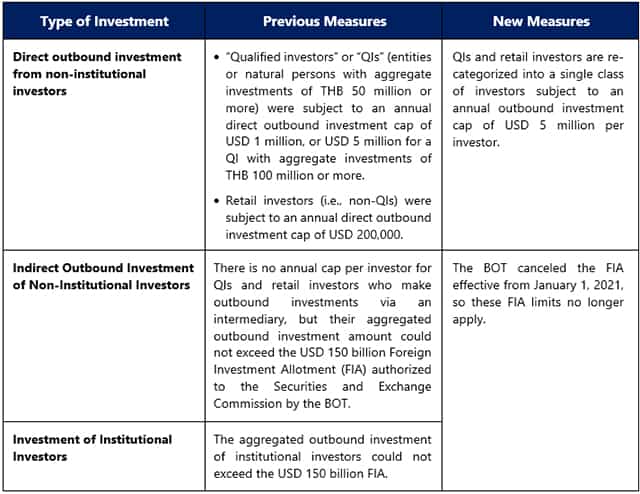
The new measures ease the individual and group limits for outbound investment as shown in the table below.
 

Types of Investment Products

The previous FX measures allowed investors to process FX transactions for investment in various types of inbound and outbound products; however, inbound products were limited to only debt instruments (e.g., bonds and structured notes) issued in foreign currency. The new FX measures expand the scope of products to include all types of investment products that reference foreign variables, such as foreign stocks, exchange traded funds, commodities, gold futures, and foreign indexes.

FX derivatives and other investment products (e.g., endowment life insurance, unit-linked life policies, and universal life insurance) are still open to outbound investment.


Foreign Currency Deposit (FCD) Accounts

The BOT also amended the requirements pertaining to foreign currency deposit (FCD) accounts. Previously, an FCD account for investment (i.e., portfolio foreign currency deposit) had to be separated from investors’ other FCD accounts. Separation of FCD accounts is no longer required, and a single FCD account can now be used for any transaction permitted by the BOT.


RELATED INSIGHTS​ 

August 11, 2026
On July 27, 2026, the State Bank of Vietnam (SBV) released a draft decree proposing amendments to Decree No. 52/2024/ND-CP dated May 15, 2024, on non-cash payments (Decree 52). The draft decree would amend 17 of Decree 52’s 38 articles, with several key changes directly affecting providers of intermediary payment service (IPS). The key proposed changes affecting IPS providers are outlined below. Streamlining IPS Licensing Procedures A central objective of the draft decree is to simplify regulatory procedures for IPS providers. Notably, it would significantly reduce IPS licensing documentation requirements by removing the need to submit enterprise registration certificates, investment registration certificates, and documents evidencing the qualifications of the legal representative and general director. Instead, the SBV would retrieve this information directly from national business registration and other specialized databases, requesting additional documents only where the relevant information cannot be verified electronically or is incomplete. The draft decree also removes the current limit of two rounds for dossier supplementation and shortens processing timelines for several IPS licensing procedures such as issuance, amendment, and reissuance of IPS licenses. The processing time for new IPS license applications would be thereby reduced from 90 to 60 working days. In addition, several continuing IPS business conditions would be removed. For example, IPS providers would no longer be required to maintain certain representations relating to corporate restructuring or the legality of contributed capital. Likewise, the IPS project plan (đề án) would become a one-time application document rather than an ongoing licensing condition. If retained in the final decree, this change could provide IPS providers with significantly greater flexibility to implement post-licensing technology upgrades, system integrations, and corporate restructuring transactions without needing to revisit the originally approved project plan. The draft decree also removes the requirement for the SBV to consult the Ministry of Public
August 4, 2026
Carbon markets have moved to the forefront of corporate and regulatory agendas as global attention to climate change and sustainability intensifies. Worldwide, many jurisdictions—including Thailand—are finding carbon markets to be promising tools in their efforts to combat climate-warming emissions and accelerate their net-zero pathways and sustainability commitments. According to the Thailand Greenhouse Gas Management Organization’s (TGO) 2025 Voluntary Carbon Market Survey, approximately 3.29 million tonnes of CO₂ equivalent (tCO₂eq) were traded under Thailand’s domestic standard between 2020 and 2024 with a cumulative market value of approximately THB 314.5 million (approximately USD 9.43 million), and 524 projects had been registered under the Thailand Voluntary Emission Reduction Program (T-VER) framework. Carbon Credits in Thailand Thailand’s carbon credit regime is, at present, entirely voluntary. There is not yet any obligation for businesses to purchase or retire carbon credits, although this may change once the draft Climate Change Act is enacted. The draft Climate Change Act, which is currently undergoing legal review before submission to Parliament, is expected to introduce a mandatory emissions trading system (ETS), under which  legal entities in designated sectors will be allocated emissions allowances and will be required to surrender sufficient allowances to cover their verified emissions, with penalties for shortfalls. Rather than imposing a blanket obligation on all businesses to purchase or retire carbon credits, the draft act is expected to allow ETS-covered entities to use eligible carbon credits (for example, those certified under T-VER) to meet only a limited, capped portion of their compliance obligation, with the applicable cap and eligibility criteria to be set out in subordinate regulations and the relevant allocation plan. The principal domestic framework for carbon credits is the T-VER, administered by the TGO. While some project developers in Thailand also operate under international standards such as Verified Carbon Standard or the Gold
August 3, 2026
On July 23, 2026, the Bank of Thailand (BOT) released for public comment its draft Notification on Digital Channel Security, which would significantly expand the scope and stringency of Thailand’s existing mobile banking security framework. If finalized in its current form, the draft notification would extend mandatory security requirements to credit card providers and credit providers, cover internet banking in addition to mobile applications, phase out SMS one-time passwords (OTPs) for transaction authentication, and introduce biometric verification requirements for high-value transactions. The public comment period is open through August 24, 2026. Background The BOT’s existing Mobile Banking Security Notification, issued in 2024, sets minimum security standards for financial institutions, specialized financial institutions (SFIs), and e-money providers, significantly reducing “money-draining app” fraud. However, fraudsters have since shifted to nonbank providers and internet banking channels, prompting the BOT to propose broader security requirements. Expanded Scope of Regulated Entities and Channels The existing Mobile Banking Security Notification covers only financial institutions, SFIs, and e-money providers offering mobile banking services. The draft expands coverage in two key areas: entities and channels. On the entity side, it adds credit card providers and credit providers that offer fund transfers to third parties at other financial service providers or that provide cash withdrawal services to individual retail customers. On the channel side, it broadens coverage to include internet banking in addition to mobile banking. Strengthened Customer Authentication The draft introduces enhanced authentication requirements in three areas: Service enrollment and device changes. Providers must implement rigorous identity verification, notify customers of enrollment results through out-of-band communication channels, and adopt risk-mitigation measures such as cooling-off periods and temporary transaction limits. Transaction-level authentication. Providers must use two-factor authentication for fund transfers, cardless ATM withdrawals, and transaction limit increases. Secure authentication factors. Key requirements include the following: “What-you-know” factors must
July 27, 2026
A new decree on penalties for violations related to the crypto asset market creates compliance risks for offshore crypto asset exchanges in Vietnam that do not hold, and practically cannot obtain, a Vietnamese license, and for Vietnamese users who continue to transact on those platforms. Decree No. 284/2026/ND-CP (Decree 284), issued by the government of Vietnam on July 16, 2026, formally establishes an administrative penalty framework for violations related to crypto assets and the crypto asset market. The decree takes effect on September 1, 2026, and will remain in force for the duration of the five-year pilot program under Resolution No. 05/2025/NQ-CP, which is scheduled to end in September 2030. Direct Penalties on Vietnamese Users The most immediate commercial risk to offshore platforms is that their Vietnamese users now face direct personal liability for using their exchanges. Vietnamese users who trade crypto assets outside of a Ministry of Finance-licensed service provider face fines of up to VND 50 million (approximately USD 1,900). Vietnamese users trading in crypto assets that are offered or issued to foreign users face higher penalties of up to VND 100 million (approximately USD 3,800). It is expected that Vietnamese users will be more willing to migrate away from offshore platforms now that there is a risk of real enforcement against them. Penalties on Unlicensed Service Providers Violations of providing crypto asset services or advertising crypto-related services without a license face fines of up to VND 200 million (approximately USD 7,700). Operating a crypto asset trading market without proper authorization falls within the same highest penalty bands. Organizations that violate issuance, provision, or disclosure rules may face fines of up to VND 200 million. Although the maximum administrative fine per violation is capped at VND 200 million for organizations and VND 100 million for individuals, these