
You are using an outdated browser and your browsing experience will not be optimal. Please update to the latest version of Microsoft Edge, Google Chrome or Mozilla Firefox. Install Microsoft Edge

May 19, 2020

Reinsurance Revolution in Myanmar

On May 12, 2020, Myanmar’s Insurance Business Regulatory Board (IBRB) issued Directive 4/2020—a game-changer for the insurance industry in Myanmar. Previously, reinsurance in Myanmar had only been available through the state-owned Myanma Insurance, without competition. However, when this directive comes into force on October 1, 2020, insurance companies (or cedants) will be able to obtain reinsurance from other insurers or reinsurers within Myanmar or abroad, with certain restrictions.

Reinsurance (and retrocession—the insurance or reinsurance of reinsurers) is a critical part of the insurance industry because it allows insurance companies to spread their risk and remain solvent in the event of large claims. It is expected that this new directive will result in Myanmar insurers—already undergoing tectonic shifts following the introduction of five foreign life insurer licenses and six foreign-Myanmar insurance joint ventures—seeking substantial reinsurance outside Myanmar. This greater spreading of insurance risk is a very positive development for the insurance market in Myanmar.

Reinsurance and Risk Retention

Under the directive, every insurer in Myanmar must retain risk up to the maximum amount commensurate with its financial strength, and must formulate a suitable retention policy for each insurance segment. In the case of life insurers and reinsurers transacting life insurance business, that must be a minimum of 20% of the sum at risk.

Every Myanmar insurer must also formulate a reinsurance program and retention policy and submit it to the IBRB at the beginning of each financial year.

Reinsurers and Licensing

Any reinsurer who wishes to operate within Myanmar must have a reinsurance license from the IBRB.

Foreign reinsurers or cross-border reinsurers who do not have a license to conduct insurance business in Myanmar will now also be permitted, subject to the following conditions:

  • They must have been licensed in their home country for at least the past three continuous years;
  • They must have a credit rating of at least BBB from S&P or equivalent for at least the past three continuous years;
  • They must have maintained a minimum solvency margin or capital adequacy as specified by their home country regulator for at least the past three continuous years;
  • Their past claims settlement must be satisfactory to the IBRB; and
  • They must comply with other requirements that may be stipulated by the IBRB.

Engaging a Reinsurer

Other than for life insurance, insurers must offer the best terms obtained to reinsurers in the following order:

  1. Myanma Insurance;
  2. Myanmar reinsurers or foreign reinsurers with representative offices in Myanmar; and
  3. Foreign reinsurers.

Insurers are obliged to follow this order of priority only if the terms offered are equaled (or bettered).

Again, other than life insurance, the IBRB has placed the following limits on cession to foreign reinsurers:
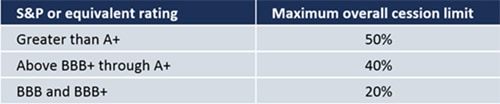
However, there is one catch that may prove frustrating. Section 20 of the directive provides that every Myanmar insurer, Myanmar reinsurer, and foreign reinsurer must cede a compulsory maximum of 10% of any insurance segment business to Myanma Insurance. Myanma Insurance is free to accept or reject the cession and will presumably be able to impose upon it such terms as it sees fit. Only if Myanma Insurance fails to offer such reinsurance is the insurer free to obtain cross border reinsurance from a foreign reinsurer for that original 10%. It seems probable that this provision will have a negative effect, because it will likely result in insurers being forced to comply with uncommercial terms from Myanma Insurance, despite better terms being available in Myanmar or abroad.

Insurance Pools

Insurance pools are another method by which smaller insurance companies can share risk. Insurance pools may now be formed in Myanmar, subject to a proposal being made to and approved by the IBRB.

Conclusion

Despite what some may see as the unwelcome involvement of Myanma Insurance, this directive is undoubtedly a giant step forward in the further liberalization and spreading of risk within the Myanmar insurance market, and is likely to herald large changes in reinsurance and retrocession both inside Myanmar and beyond.

For more information on this development, or on any aspect of doing business in Myanmar, please contact Tilleke & Gibbins’ Yangon office on [email protected]

RELATED INSIGHTS​ 

June 30, 2026
Tilleke & Gibbins’ insurance specialists in Bangkok provided Thomson Reuters’ latest country update on Thailand’s regulatory framework for the insurance industry. The country update, which is part of Thomson Reuters’ extensive Regulatory Intelligence offerings, contains information and guidance for insurers active in the Thai market. The guide covers the following topics in detail: Permission to operate; Legal and regulatory considerations for domestic and international insurers; Capital reserve requirements; Investment management and markets; The Office of Insurance Commission’s arbitration system for handling complaints; Creditor hierarchy; Rehabilitation of non-life insurance companies; and Personal data protection requirements for insurers. Thomson Reuters Regulatory Intelligence is a service that provides with curated news, analysis, and data across jurisdictions to help legal, risk, and compliance professionals manage compliance and mitigate global risk. The full Thailand insurance country update is available by subscription to Regulatory Intelligence on the Thomson Reuters website.
June 30, 2026
Insurance specialists from Tilleke & Gibbins have provided an update to the Vietnam chapter of Thomson Reuters’ Practical Law guide to insurance and reinsurance. The guide is a Q&A-style overview of insurance and reinsurance law in jurisdictions worldwide. The Vietnam chapter provides a detailed overview of the legal framework for the insurance and reinsurance market in the country, covering the following issues: Regulatory framework for insurance and reinsurance Authorization for insurers, reinsurers, and insurance intermediaries Ownership restrictions Ongoing requirements Penalties for noncompliance Sales and marketing of insurance and reinsurance Transfer of risk Reinsurance contracts and risks Contracts and policies Claims Dispute resolution Insolvency Tax Practical Law, a legal reference resource from Thomson Reuters, publishes a range of guides for hundreds of jurisdictions and practice areas. The insurance and reinsurance guide is a valuable resource for legal practitioners, covering numerous jurisdictions worldwide. To view the latest version of the guide, please visit the Practical Law website and enroll in the free Practical Law trial to gain full access.
June 5, 2026
Thailand’s Office of Insurance Commission (OIC) has opened a public hearing on proposed amendments to the OIC Notification on Criteria for Information Technology Risk Governance and Management for Life Insurance and Non-Life Insurance Companies B.E. 2563 (2020) via the centralized Law platform. The public consultation period runs from May 8, 2026, to June 9, 2026. The proposed amendments aim to elevate the IT risk governance and cybersecurity risk management framework to be more modern and aligned with international standards, with a focus on strengthening cyber resilience, enhancing the role of IT audits, and establishing data governance and data quality controls. The parties affected by these amendments include life insurance companies, non-life insurance companies, and external IT auditors. Key Changes Elevated Role of Board of Directors The proposed notification requires the company’s board of directors to oversee data governance, cybersecurity, and the responsible use of AI. Additionally, the board should include at least one director with IT knowledge or experience. Companies are also required to designate a head of security responsible for information security. The board’s duties are expanded to include oversight of data governance and AI usage, including establishing relevant policies and committees. Enhanced IT Security and Cybersecurity The revised notification consolidates the existing chapters on IT project management, IT security and cybersecurity to reduce redundancy, and introduces significant new measures. These include mandatory multi-factor authentication for material systems, enhanced data security measures such as data masking and data leakage prevention, security hardening requirements, web filtering, and mandatory vulnerability assessment and penetration testing at least annually. New requirements are also introduced for mobile application security, API security, and security measures for emerging technologies such as cloud computing and post quantum cryptography. The cybersecurity framework now encompasses identification, protection, detection, response, and recovery. The draft also introduces source code review
April 9, 2026
Thailand’s Office of the Insurance Commission (OIC) has published two parallel sets of draft regulatory amendments for public hearing—one governing non-life insurance and the other governing life insurance. The proposed amendments would significantly revise the rules for issuing, offering, and selling insurance policies, as well as the conduct of agents, brokers, and banks. Stakeholders may submit comments until April 25, 2026. The key proposed changes are summarized below. Electronic Policy Delivery by Default Under both draft amendments, electronic delivery would become the default method for delivering insurance policies. A printed copy would be required only if the policyholder expressly opts out, and any such printed copy would be treated as a substitute for the electronic original. For life insurance, this requirement would also extend to coverage summaries and to exclusion documents. The OIC would also retain authority to approve alternative delivery methods for specific types of policies. Misuse of Licenses Both amendments would introduce an explicit prohibition against sales representatives using another person’s name or license, or allowing another person to use their name or license, in connection with the offering of insurance or in sales documentation and policies. Premium Collection Reforms Both amendments would introduce the premium collection reforms outlined below. Premium receipt accounts Insurers must ensure that sales representatives inform customers of the available payment channels, which are limited to channels that remit premiums into the insurer’s account. If a customer pays an insurance premium to an insurer’s employee, an insurance broker, or any other person, and the company acknowledges the payment by issuing an insurance policy or other documentary evidence of insurance coverage, the insurer would be deemed to have received the insurance premium. Written premium collection and refund guidelines Insurers would be required to prepare written internal guidelines covering premium collection and refund policies, risk