
You are using an outdated browser and your browsing experience will not be optimal. Please update to the latest version of Microsoft Edge, Google Chrome or Mozilla Firefox. Install Microsoft Edge

December 6, 2018

Case Studies on Board of Patents’ Decisions Relating to Product Design Novelty

Informed Counsel

To be eligible for a design patent under Thai law, a product design must be novel and industrially applicable. A product design is considered to be novel if, before the application is filed, the design:

  • is not widely known or used in Thailand;
  • is not disclosed or described in Thailand or another country;
  • is not published; and
  • does not sufficiently resemble any previous designs to be considered an imitation.

These criteria, stipulated by law, are deliberately straightforward so that unpatentable product designs can be easily weeded out. However, when a design patent application is filed for a design that is similar in appearance to a publicly available product, it can be challenging to assess whether the new application will be granted. This article takes an in-depth look at two cases that fall under this scenario, the reasoning that the Board of Patents (BOP) adopted in addressing them, and the ultimate decisions that it reached.

Case Studies

On June 27, 2018, the BOP ruled that a design for roofing plates was novel, compared to four prior art designs for existing patents.
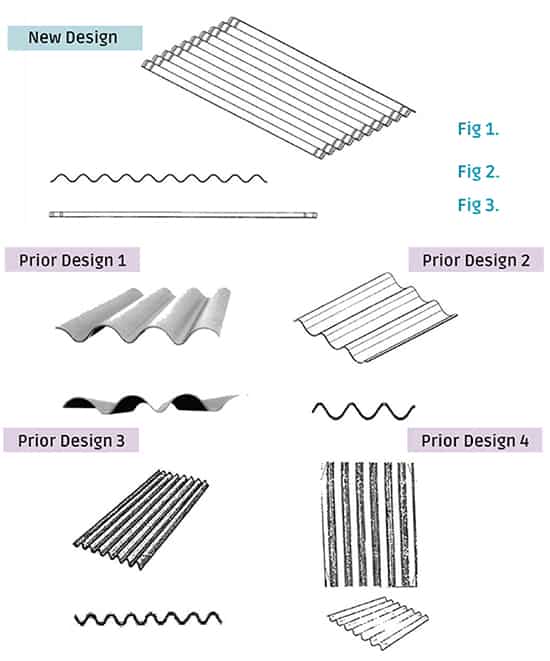
The BOP compared the new design to the four existing designs in order to determine whether the new design was recognizably different. In deliberating the case, the BOP found that the new design featured a roof tile with a wave pattern in which the upper and lower waves were the same size and appearance. Additionally, the two-stripe patterns, oriented in a perpendicular direction to the waves and located at both ends of the roof tile, were held to be a unique feature. These combined characteristics passed the novelty test and led the BOP to render the design as novel compared to the existing patents.

Approximately one month after the decision in the roofing plates case was rendered, the BOP dismissed a design patent application for a screw cap for a jar on the grounds that it was substantially similar to a prior art design for an existing patent. 


According to the BOP, the new product design comprised a round cap with a flat top and bottom and convex vertical strips along the outer edge. In addition, a vertical cross-section of the cap featured a flat surface with a groove. Ultimately, these elements were found to be substantially similar to the prior art design. Although the grooves of the new design were wider and deeper than those of the prior art, these differences were insufficient for the design to be considered novel.

Conclusion   

In the deliberation of both cases, the BOP considered each element of the new product design, and the overall appearance, and compared them to prior designs. If they found that the combined elements created an overall appearance that was sufficiently different from the previous design, then the new product design was deemed to be novel.   

The BOP’s decisions on these two cases make it clear that, when comparing prior art designs to the design in a new application, the focus goes beyond merely identifying unique parts. The BOP also pays considerable attention to the cohesiveness of the overall appearance of the product. As shown in the second case, a design will not be considered as novel if it is substantially similar to existing designs in overall appearance. However, individual elements can help to distinguish the overall appearance of a design from other existing designs, and thus make it patentable.    

One practical upshot of this is that it is prudent to point out all unique and unifying elements of a design when filing a response to an office action or appeal to the BOP regarding the novelty of a product design. This strategy can be very useful in successfully registering a challenged application.

RELATED INSIGHTS​ 

August 20, 2026
As part of its membership in Lex Mundi, Tilleke & Gibbins has released the latest edition of its Guide to Doing Business in Thailand, providing an overview of the legal, regulatory, and commercial considerations for companies establishing or expanding operations in Thailand. The 2026 edition offers practical insight into the country’s business environment, investment framework, and operational requirements. The guide covers a wide range of topics relevant to foreign and domestic investors, including: Investment incentives and promotion schemes Financial facilities and banking regulations Exchange controls and money transfers Import and export regulations Business structures and incorporation options Requirements for establishing a business Operational and compliance considerations Business cessation and insolvency procedures Employment and labor laws Taxation Immigration and visa requirements Prepared by Tilleke & Gibbins lawyers across multiple practice areas, the publication outlines key aspects of doing business in Thailand, including foreign investment restrictions, regulatory compliance obligations, corporate structures, employment requirements, and recent legal and economic developments affecting investors. The publication forms part of Lex Mundi’s Country Guides series, a global collection of jurisdiction-specific reference materials prepared by member firms around the world. Together, these guides help companies evaluate opportunities, compare regulatory environments, and plan international business activities across multiple markets. The full Guide to Doing Business in Thailand 2026 is available through the button below.
August 13, 2026
Modern agricultural machinery is no longer purely mechanical but instead technology dependent. Modern tractors, harvesters, and other farm equipment increasingly incorporate embedded software, electronic control units, sensors, and digital diagnostic systems. While such technologies enhance efficiency, productivity, and precision farming, they also affect the manner of equipment repair and maintenance. As a result, farmers and independent repair providers may have little practical choice but to rely on authorized dealers, even for routine maintenance and repairs. Section 36 of Thailand’s Patent Act reflects the principle that the authorized sale of a patented invention usually exhausts the exclusive right of the patent owner over the specific product. This means that upon legal sale of the patented product, it can typically be used or resold without further authorization from the patent holder. This principle is relatively straightforward when applied to traditional mechanical equipment. Ownership of a machine ordinarily carries with it the practical ability to diagnose faults, replace worn parts, and restore the equipment to working order. Modern agricultural machinery, however, increasingly depends on embedded software, proprietary diagnostic systems, firmware updates, and other digital resources that may remain under the control of the manufacturer or patent holder. This tension lies within the “right to repair” debate. In the United States, on July 8, 2026, the Federal Trade Commission and five states announced a settlement with Deere & Company resolving allegations that Deere had unlawfully restricted farmers’ and independent repair providers’ ability to repair their equipment. Under the terms of the settlement, for the next ten years, Deere must provide repair resources, including software capabilities, on terms equivalent to those provided to authorized dealers. The Deere settlement highlights that the nature of ownership is changing, but legal concepts have not kept pace. Traditional patent-law concepts, including patent exhaustion, were developed with physical products
August 10, 2026
Thailand has finalized its social media KYC (“know your customer”) rules under Notification of the Electronic Transactions Commission on Measures to Prevent Technological Crimes for Social Media Service Providers (No. 2), which was published in the Government Gazette on May 5, 2026, and will take effect on November 1, 2026. While an early draft of the notification proposed requiring social media platforms to arrange identification of every user account, the final notification is significantly more targeted, focusing on paid online advertising and advertiser identity verification. Though the regulatory initiative primarily aims to combat online fraud and technology-related crimes, it also has important consequences for intellectual property enforcement, because the verified platform records that will be generated under the new requirements can help IP rights holders to identify anonymous online infringers. Key Regulatory Mandates The notification requires social media service providers to verify the identity of advertisers before their paid advertisements are published and disseminated in Thailand through social media, regardless of whether the advertising fees come from the advertisers or third parties. Verification of an advertiser is valid for one year, after which verification would have to be performed again before the platform could publish additional paid advertisements from the advertiser. Permitted verification methods are specified under the notification. A platform may verify an advertiser by checking identity evidence and confirming the connection between the advertiser and that identity evidence, with the notification giving facial comparison against certain government-issued identity documents as an example. Alternatively, platforms may verify advertisers through a digital identity verification and authentication system with an identity-proofing assurance level not lower than the level prescribed by Thailand’s Electronic Transactions Commission. The notification further requires platforms to retain only the advertiser’s information necessary to identify the advertiser, beginning from the start of the advertising activity and for
August 6, 2026
Introduction: A Trademark Paradox in Sustainable Packaging Walk into any Thai supermarket, and the label-free water bottle is no longer a novelty. Thailand’s packaging market, valued at approximately USD 15.68 billion in 2025, is shifting toward minimalist, plastic-light designs as ESG pressures reshape how brands present their products. The country generated roughly 5.68 million tons of plastic waste in 2021, with a recycling rate of only 19 percent, and regulators are now considering rules that would allow label-free bottled water relying on embossing, laser printing, or QR codes instead of wrap-around labels. As packaging itself becomes the brand identifier, a paradox emerges: designs built to say the least often struggle hardest for protection under Thai intellectual property law. The Trademark Barrier: When Shape Is Not Enough Section 7, paragraph 2(10) of the Thai Trademark Act deems a shape distinctive only if it is not the natural form of the goods, is not necessary to achieve a technical result, and does not add value to the goods. The Department of Intellectual Property’s 2022 examination guidelines apply this test conservatively, as the following examples illustrate. A plain water bottle relying on subtle contours to signal its brand is typically read as just another bottle, not a source identifier. Acquired distinctiveness offers a theoretical escape route, but it demands extensive evidence of sales, advertising, and consumer recognition—an especially heavy burden for new entrants whose minimalist packaging has not yet achieved market prominence. The result is a structural bias against precisely the design innovation that sustainability goals are meant to encourage. Design Patents: A Partial, Imperfect Substitute Design patent protection, covering a product’s shape, configuration, or ornamentation, appears to offer an alternative route. In practice, it is constrained by the same forces driving the minimalist trend. Because many brands converge on similar solutions—clear