You are using an outdated browser and your browsing experience will not be optimal. Please update to the latest version of Microsoft Edge, Google Chrome or Mozilla Firefox. Install Microsoft Edge

January 12, 2022

BOI Expands Promoted Activities for Electric Vehicle Manufacturers

Thailand’s Board of Investment (BOI) recently published BOI Notification No. Sor. 8/2564, which extends the scope of investment promotion covering electronic vehicle (EV) industry manufacturers to include the production of “automotive platforms” for electric vehicles, and creates a new category of BOI promoted activities covering the manufacture of electric bicycles (E-bikes).

Automotive Platforms

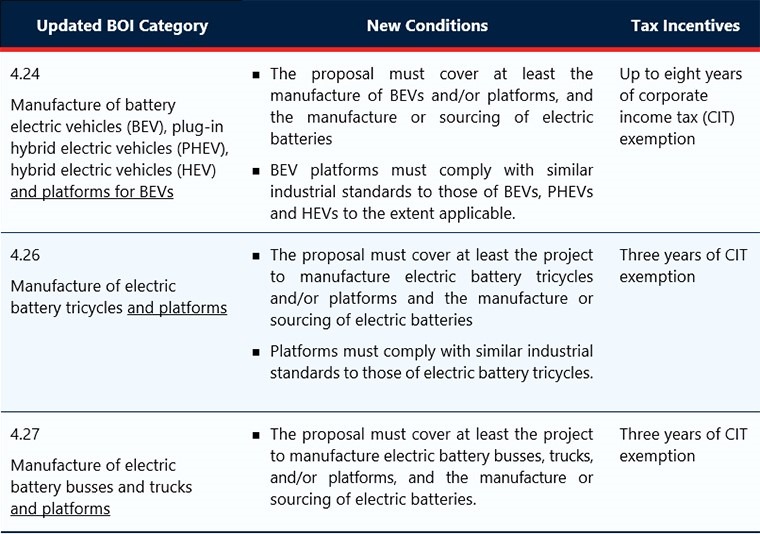
The following investment promotion categories have been extended:

  • 4.24 – Manufacture of Battery Electric Vehicles
  • 4.26 – Manufacture of Electric Battery Tricycles
  • 4.27 – Manufacture of Electric Battery Busses and Trucks

These categories now include the manufacture of “automotive platforms”—which must include an energy storage system, charging module, and front and rear axle module—benefiting from similar tax incentives and subject to additional conditions, as detailed below.
New BOI Promotional Category for E-Bike Production

The BOI has also introduced a new category, No. 4.28, covering the manufacture of E-bikes. Projects under this category will be eligible for a three-year CIT exemption with an additional one-year exemption if certain criteria are met.

Applications for this category must cover the manufacture of E-bikes, the manufacture or sourcing of electric batteries, and a management plan for used batteries.

In addition to the general conditions for EV projects (industrial standards, manufacturing timelines, etc.), the BOI has also imposed the following conditions specific to E-bike projects:

  • E-bike frames must be produced from light-weight materials such as aluminum alloy, chromium–molybdenum alloy steel (chrome moly), titanium alloy, and carbon fiber; and
  • E-bike batteries must adopt environmentally-friendly technology.

Interestingly the BOI allows E-bike production lines to jointly use manufacturing lines for ordinary bicycles. However, the sale of ordinary bicycles is regarded as non-BOI-promoted income and will not be entitled to BOI tax incentives.

These new provisions, intended to stimulate both local and foreign investments in the electric automotive industry, seem to complete the BOI promotion scheme for the full range of electric vehicles. They will hopefully accelerate the expansion of Thailand’s electric vehicle production market, and the adoption of environmentally friendly vehicle technology in Thailand.

For more details on any aspect of investment promotion in Thailand, please contact Napassorn Lertussavavivat at [email protected] or +66 2056 5662, or Supasit Saypan at [email protected] or +66 2056 5994.

RELATED INSIGHTS​ 

September 24, 2026
Vietnam is implementing and developing a broad package of regulatory reforms that could reshape how IP, data, digital platforms, and product authenticity are regulated and enforced. Several of the key measures have been led by the Ministry of Public Security in its legislative and administrative capacity, as part of a broader government effort. The core reform package consists of four key legal instruments: proposed amendments to the Criminal Code, a proposed new Data Security Law, a draft Decree on Product Identification, Authentication and Traceability, and the newly enacted Decree No. 330/2026/ND-CP. These instruments include rules on criminal enforcement, data security, electronic identification, product identification and traceability, administrative violations, and cybersecurity sanctions. Combined, these measures will affect copyright enforcement, industrial property rights, trade secrets, AI training data, product provenance, online takedowns, valuation of counterfeit goods and electronic evidence. It is worth noting that, in addition to strengthening criminal penalties for IP crimes, Vietnam’s emerging regulatory framework increasingly treats infringement, data misuse, product authentication, and platform-enabled violations as interconnected regulatory and enforcement challenges. For rights holders and foreign investors, this could mean stronger tools against counterfeiting and online infringement, but also more compliance obligations around data, traceability, AI, platform controls and government-facing reporting. Expansion of Criminal IP Enforcement Proposed amendments to Article 225 of the Criminal Code would expand criminal copyright exposure beyond reproduction and distribution to cover large-scale commercial public performance and online communication of works, phonograms and video recordings. This is important because piracy is increasingly about streaming, unauthorized communication, and platform access models rather than physical copying. Aggravated copyright infringement could be subject to up to 10 years in prison for individuals and fines of up to VND 6 billion (about USD 228,300) for commercial legal entities. The amended Article 226 would expand criminal industrial property liability beyond
September 17, 2026
Thailand’s Office of the Consumer Protection Board (OCPB) has released for public comment a draft bill to amend the Consumer Protection Act B.E. 2522 (1979), the country’s foundational consumer protection legislation. The draft amendment aims to modernize the nearly five-decade-old framework to address the rapid growth of digital commerce, online advertising, influencer marketing, and new business models. The public consultation period is open until October 10, 2026. Expanded Definitions Covering Digital Commerce The draft significantly broadens several core definitions to capture modern commercial activities: “Consumer” is expanded to include natural persons and nonprofit juristic persons who purchase or receive services, including those solicited by businesses and end users who do not directly pay for the goods or services. “Business operator” now explicitly covers advertising business operators and hired advertising persons, such as influencers and content creators. “Advertising media” is expanded to include digital platforms, social media, and social media user accounts. “Label” now encompasses electronic labels—symbols, codes, or other electronic formats displaying product information. Influencer and Advertising Disclosure Requirements In addition to these expanded definitions, “hired advertising person for selling goods or services” is a new definition covering influencers, content creators, live streamers, affiliate marketers, and virtual online media operators who receive monetary compensation or other benefits for advertising goods or services. Hired advertising persons—including influencers and content creators—must disclose to consumers that content is advertising and reveal their relationship with the business owner. Disclosure is required when the business owner employs the advertiser, pays or provides other benefits for the advertisement, or provides free or discounted products or services. These requirements apply where consumers would not otherwise know that the business has a connection to the person presenting the content. Labeling Requirements for Importers The draft introduces a clearer labeling obligation for importers of label-controlled goods, who must
September 11, 2026
Thailand’s National Broadcasting and Telecommunications Commission (NBTC) has published a new five-year master plan that will bring significant regulatory changes to the broadcasting and digital media sectors, including formal licensing requirements for internet-based audiovisual services. The Master Plan for Broadcasting and Television, 3rd Edition (B.E. 2569–2573/2026–2030) was published in the Government Gazette on September 1, 2026, and will affect OTT platforms, internet-based audiovisual service providers, and traditional broadcasters. Licensing Reform The NBTC will develop new licensing frameworks ahead of existing digital television license expirations, which are slated to occur between 2028 and 2030. This creates both uncertainty and opportunity for incumbents and new market entrants. New licensing criteria will also be developed for audiovisual services delivered over the internet, meaning previously unregulated internet-based providers may face licensing, fee, and content obligations for the first time. The plan also calls for a new law to govern converged communications services. OTT Regulation and Content Oversight The plan explicitly acknowledges and aims to lessen the regulatory asymmetry between traditional broadcasters—which are subject to licensing, fees, and content regulation—and internet-based services that currently face fewer obligations. The NBTC intends to develop regulatory frameworks to bring internet-based audiovisual services, including OTT platforms, streaming services, and user-generated content platforms, under content, consumer protection, and licensing requirements. Consumer Protection and Digital Rights The NBTC will strengthen its oversight of broadcasting, television, and telecommunications operators to ensure compliance with consumer protection and personal data protection requirements. This includes updating relevant notifications and orders and more strictly enforcing rules against practices that unfairly exploit consumers. These measures may layer NBTC-specific requirements on top of Thailand’s existing Personal Data Protection Act obligations. Stricter enforcement against practices that exploit consumers is a priority, with particular scrutiny on advertising practices. The NBTC will modernize complaint resolution processes, meaning service providers should
September 7, 2026
On September 4, 2026, Thailand’s prime minister convened the first meeting of the Data Center Business Policy Committee. The committee endorsed a draft policy framework for the data center industry and tasked four subcommittees with developing the standards that would sit beneath it, shifting away from fragmented, agency-by-agency approvals toward a unified national strategy aiming to maximize economic value while managing environmental and infrastructure concerns. Proposed Scope and Pillars of the National Data Center Policy Framework The proposed framework would cover all types of data centers, including internal or captive facilities operated within a company or its affiliates, rather than only commercial third-party providers. If adopted in this form, companies running private data centers purely for internal purposes would also become subject to regulatory oversight. Minimum safety and operational standards would be established, with uniform enforcement across all categories. The committee endorsed a draft policy framework with four key pillars: Industrial classification: Data centers exceeding 2 MW would be classified as industrial operations, which may require factory licenses and environmental impact assessments under the Factory Act. Resource pricing: Utility rates would be structured to reflect both direct and indirect costs, supporting green energy and green data center standards. Centralized screening: A centralized review would evaluate project suitability and resource allocation. Operators may be required to submit proposals through periodic “pitching” rounds, where projects are competitively assessed on their potential economic and strategic benefits to Thailand. Digital ecosystem: The framework would prioritize data sovereignty, tax incentives, and conditions promoting domestic digital businesses, AI, and cloud infrastructure. Multidimensional Evaluation Criteria and Subcommittees Four subcommittees will be established to develop standards responsible for the following dimensions: Economic: Criteria for assessing the economic viability of data center projects, for use in prioritizing data centers based on infrastructure readiness, demand type (including AI factories),