You are using an outdated browser and your browsing experience will not be optimal. Please update to the latest version of Microsoft Edge, Google Chrome or Mozilla Firefox. Install Microsoft Edge

December 31, 2021

VAT Reduced to 7% under Amendments to Lao Tax Laws

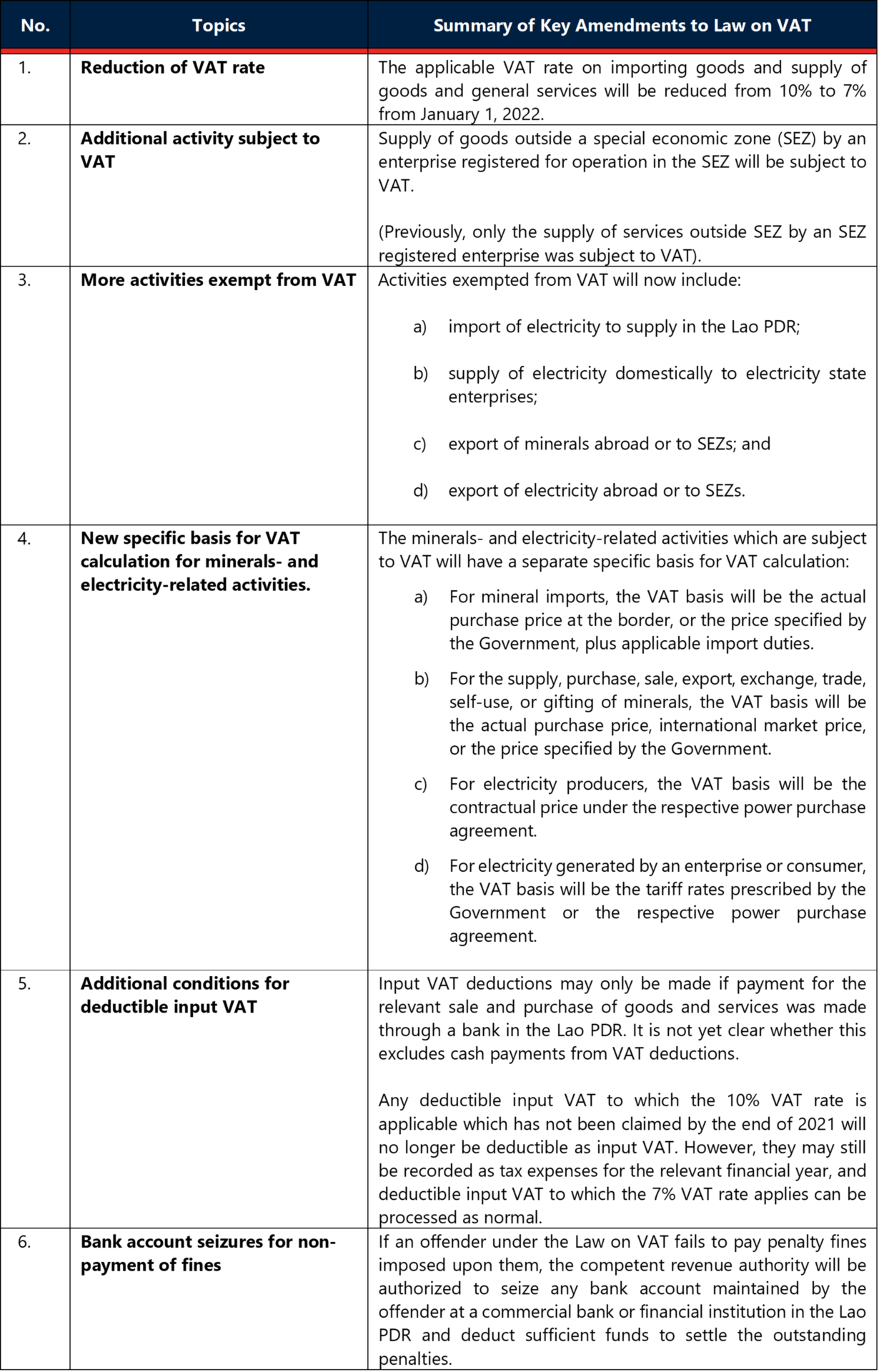
In the last week of December, 2021, the Ministry of Justice published the Law Amending Certain Provisions of the Laws on Tax No. 01/NA, dated August 7, 2021, in the Government Gazette. The Law will come into force on January 1, 2022.

The most notable amendments relate to Value Added Tax (VAT), which are summarized below.

The new law also makes changes to the laws on tax management, income tax, and excise tax, which Tilleke & Gibbins will provide updates on in due course.

RELATED INSIGHTS​ 

March 20, 2026
Myanmar has introduced a comprehensive new regulatory framework for alcoholic beverages that will impose stricter controls on production, distribution, advertising, and sales. On March 7, 2026, the National Defence and Security Council issued a new Excise Law (NDSC Law No. 13/2026), repealing the Excise Act of 1917. The law, which has not yet entered into force, will take effect on a date to be specified in a separate notification—likely within this year. The new Excise Law establishes clearer definitions, introduces multiple categories of excise licenses and permits, and significantly expands prohibitions and compliance obligations for businesses operating in the alcohol sector. Many operational details will be clarified through implementing rules and notifications. Scope and Definitions The new law defines “excise” to cover alcoholic liquor and excisable articles. Alcoholic liquor is broadly defined as any liquid containing more than 0.5% ethyl alcohol, including beer, wine, toddy sap, fermented liquor, and any other liquid declared as alcohol by notification of the relevant ministry, excluding denatured alcohol. Alcoholic liquor is further categorized into country liquor, foreign liquor, and international‑standard domestically produced liquor. Excise Licensing The law also introduces a more detailed licensing regime. The following types of liquor excise licenses are available: Production Production of value-added products Bottling Distribution Sales Other excise‑related businesses designated by General Administrative Department (GAD) notification The GAD will prescribe the licensing fees, requirements, and conditions for each category through notifications issued with the approval of the Ministry of Home Affairs. The GAD may also, with the approval of the Ministry of Home Affairs, prescribe quantities and volumes of alcoholic beverages that may be possessed without a liquor license. No such prescribed quantities have yet been issued. Holders of excise licenses for manufacturing, production of value-added products, or bottling must obtain approval from the relevant government department or
March 19, 2026
Thailand’s Electronic Transactions Development Agency (ETDA), which describes itself as a “co-creation regulator” working collaboratively with industry rather than imposing top-down rules, has unveiled its regulatory roadmap for digital platform businesses under the Royal Decree on Digital Platform Service Businesses B.E. 2565 (2022). The 2026 regulatory approach is guided by three core principles—“practicable, verifiable, shared responsibility”—aimed at elevating digital services to be safe, transparent, and fair. These principles inform ETDA’s 2026 priorities, which focus on three key dimensions: product and service standards on platforms, fair competition and fee transparency, and online fraud prevention. Product and Service Standards ETDA’s 2026 agenda addresses product and service standards across several platform categories: Online marketplace platforms. The Notification on Additional Measures for Online Marketplace Platforms under Section 18(2) came into force on December 31, 2025, designating 21 marketplace platforms that must verify products and merchants. Among other obligations, covered platforms must remove or suspend substandard products under the “notice and take down” principle. The ETDA has collaborated with the Food and Drug Administration and the Thai Industrial Standards Institute to develop inspection manuals and coordinate compliance procedures. Social commerce. The ETDA is preparing a new notification under Section 18(2) specifically targeting social commerce platforms with sales support functions, aiming to align regulation with evolving digital market conditions. Ride sharing. Since the postponement of the deadline to comply with the ETDA’s notification on ride-sharing platforms to March 31, 2026, the ETDA has supported drivers in registering with the Department of Land Transport through the Driver Verify registration system, which has already issued certifications to approximately 27,900 riders. The ETDA is also examining structural issues relating to appropriate insurance packages, motorcycle engine capacity expansion, and fair leasing fees and contract transfer costs in coordination with the Department of Land Transport, the Office of Insurance Commission,
March 12, 2026
Thailand’s AI legislative framework took another step forward when the Office of the Consumer Protection Board (OCPB) issued a notification establishing guidelines for AI-generated advertising that may cause material misunderstanding about products or services. The notification, which is already in effect, was issued under the Consumer Protection Act B.E. 2522 (1979) and its amendments, which prohibit advertising that is unfair to consumers or may cause harm to society, including false or exaggerated statements and statements that may cause material misunderstanding about products or services. The notification addresses emerging advertising practices, including the use of images edited using software or AI to attract consumer interest or build credibility. The OCPB noted that such advertising may result in consumers misunderstanding the essential characteristics, condition, or usage of products, which violates consumer rights and causes damage. Key Requirements on AI-Generated or Digitally Manipulated Advertising Content For advertisements using still images or videos created or edited with software programs or AI tools that may cause the depicted product or service to differ from the actual product sold or service provided—which may cause misunderstanding regarding the condition, quality, quantity, or other essential aspects of the products or services—advertisers and business operators must comply with the following requirements: Prior authorization. Obtain approval from relevant regulatory authorities where required by law. Accurate representation. Ensure that the advertised size, quantity, volume, number, or composition matches the actual product or service being sold, whether in still images or videos. Mandatory AI disclosure labels. Display clear disclosures when AI or software is used to create or edit images, such as: “Real image or simulation edited using AI” “Photo from actual location or simulation edited using AI” “Photo from actual product or edited simulation” “Image created by AI” “Video created by AI” Clarity of disclosure. Ensure disclosures are clearly visible,
March 9, 2026
Over the past several years, numerous automobile manufacturers have brought electric vehicles (EVs) to the market and received positive feedback from consumers in Thailand and around the world. EVs have gained popularity due to their lower maintenance costs, reduced energy expenses, and environmental benefits. However, reports have emerged of EVs causing problems such as battery fires, autopilot malfunctions leading to accidents, and safety systems such as brakes engaging automatically under inappropriate conditions. Even when these situations do not cause injury to drivers or passengers, they raise significant concerns for EV manufacturers, importers, and sellers operating in Thailand. These problems may seriously impact businesses if the products are identified as unsafe under Thailand’s Product Liability Act (PLA), officially known as the Liability for Damages Arising from Unsafe Products Act. Under this law, authorities or courts can order business operators to recall products from the market or prohibit their export, import, or sale. To manage and mitigate the risk of being found liable for damages due to an unsafe product under the PLA, EV business operators should be aware of the scope of the law. Potentially Liable Parties The PLA identifies several types of entrepreneurs and business operators—both individuals and entities—as “potentially liable parties” (PLPs) who may be held liable under the law. In the EV context, this could include vehicle manufacturers, battery suppliers, software developers whose systems are integrated into the vehicle, and local importers or distributors. Specifically, the PLA covers: Manufacturers or hirers Importers Sellers of goods for which the manufacturer, hirer, or importer cannot be identified Any other party who uses the name, trade name, trademark, or statements associated with the alleged unsafe products, or acts in a manner that causes them to be perceived as a manufacturer, hirer, or importer Definition of “Product” and “Unsafe Product” The