You are using an outdated browser and your browsing experience will not be optimal. Please update to the latest version of Microsoft Edge, Google Chrome or Mozilla Firefox. Install Microsoft Edge

August 4, 2021

Vietnam’s Approach to Secret Prior Art

Introduction

Currently, under Vietnam’s Law on Intellectual Property of 2005, as amended in 2009 and 2019 (“IP Law”), secret prior art cannot be used in evaluating patent applications. However, an approach to evaluate secret prior art has been included, for the first time, in the draft amendment of the IP Law. Below is our discussion of this interesting topic.

Recognition in Other Jurisdictions

Secret prior art is the name given to prior art that, at the time of filing of a new patent application, was not discoverable by the new applicant or not publicly available. It exists as a filed but unpublished application, unavailable to the public until publication. Until that point, only the applicants and the patent examiners of the unpublished application know of its existence. Even though it is not discoverable or available to the public, secret prior art can still be used as a bar for novelty in many jurisdictions. Secret prior art is not limited to situations in which the first applicant and the new applicant are different people; secret prior art applies regardless. There is, however, a domestic limitation: Applications filed and not yet published in a foreign country are not considered to be secret prior art.

When the applicants are different people, the new applicant has no way of discovering the secret prior art that exists as a filed and unpublished application of the first applicant. Regardless of the completeness of the patent search, the previously filed and unpublished application cannot be discovered. At the time of filing, the new applicant’s invention would seem novel. Later, it would be discovered that the application was actually filed after another application for the same invention, barring patentability. This creates confusion and unfairness among multiple applicants.

One applicant can also file two separate applications at different times, in which the later filed application claims subject matters disclosed in the earlier filed application. Thus, the earlier filed application—regardless of its availability to the public—can be used as secret prior art for barring novelty. This is called “self-collision.” Some jurisdictions allow for excluding this secret prior art because it arose from the same applicant. This is called the anti-self-collision exception. This is favorable to applicants, because otherwise their own disclosures may result in a bar to novelty in their own subsequent patent applications.

The anti-self-collision exception is not a perfect solution to the problems secret prior art creates for an applicant filing two patent applications. Normally, the subject matter disclosed in the first application could not be subsequently claimed by another party, because the first application would be considered during novelty assessment. However, with this exception, that subject matter would not be considered, which could result in an unfair patent term extension for the applicant in jurisdictions employing the anti-self-collision exception. One method for solving this situation is requiring a terminal disclaimer filed with the new application, effectively limiting its term to that of the first application.

In Vietnam

Currently, although there is no “self-collision” based on secret prior art, the Intellectual Property Office of Vietnam (IP Office) has another method for disqualification of the later-filed application without using secret prior art. The IP Office targets the later-filed application using Article 91 of the IP Law—the priority principle. The below summary of a case study may clarify this practice by the IP Office.

An applicant files two Vietnam applications—a prior application A1 (claiming priority to an unpublished application P1) and a new application A2 (claiming priority to an unpublished application P2). The inventions disclosed in A1 and A2 are considered as being similar in nature. The timeline of the related application is illustrated here for reference.
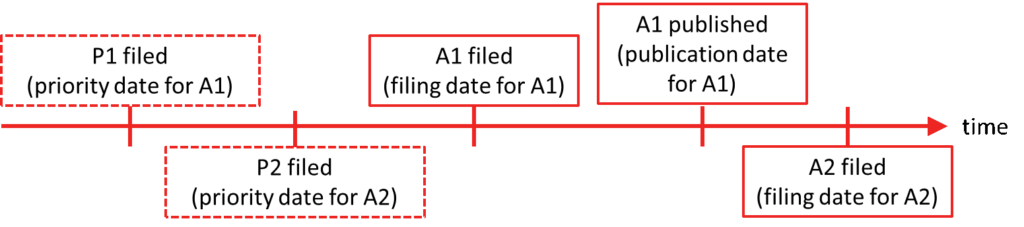
 

Under the current IP regulations, without any secret prior art concepts, A1 is not prior art against A2 if P2 is recognized as A2’s priority. However, at practical examination, this priority right is refused, creating a situation in which A1 may become a barrier for novelty of A2. See the below language from the IP Law:

Article 91. Priority principle: An applicant for registration of an invention, industrial design or mark may claim priority on the basis of the first application for registration of protection of the subject matter.”

In the view of the IP Office, upon publication of A1, it becomes publicly known that P1 is the earliest application disclosing the A1/A2 inventions. Thus, P2 is invalid as priority for A2 because it was not the first application to disclose the subject matter. Because A2’s priority date is invalid, the basis for its novelty assessment is now its filing date. Any published applications can be used as prior art that were available to the public before the claimed date. Since A1 was published before A2 was filed, A1 is used as prior art against A2, resulting in A2 being considered not novel. This priority rule approach brings the same effect to the later-filed application as would the secret prior art approach.

A New Approach

Recently, an approach to add secret prior art to the next amended version of the IP Law has been drafted. The suggested amendment and supplement to Article 60.1 of the IP Law reads as follows:

An invention in the invention registration application with a subsequent filing date or priority date is considered having lost its novelty if it is disclosed in another invention registration application with earlier filing date or priority date but published on or after the filing date or priority date of such invention registration application.

With this amendment, the IP Office would be able to directly determine novelty over a secret prior art instead of using the current methods of applying the first-to-file rule and objecting directly to the priority claim from an earlier-filed application that results in a direct/indirect pathway for barring patentability.

This proposed amendment, however, is not clear on several details. The language “another invention registration application” does not specify domestic application; thus, it is a grey area whether the secret prior art is only a Vietnam application or if it is also any overseas patent application. Further, the concept of “secret prior art” is unclear for PCT applications electing Vietnam but not actually entering the national phase in Vietnam. Finally, the amendment does not specify whether this amendment applies to utility solution applications in addition to invention applications. Hopefully, further bylaws guiding the amendments of the IP Law will address the above unclear points.

Adopting this amendment would bring Vietnam into the large group of jurisdictions that recognizes secret prior art.

This article was prepared with the assistance of international intern Alex Mischke.

RELATED INSIGHTS​ 

July 15, 2026
Ambush marketing refers to a strategy in which a business associates itself with an event, campaign, or brand without paying for official sponsorship rights. The tactic is most visible in sports, concerts, and festivals, where official sponsors have invested substantially for exclusivity. Ambush marketers may use suggestive wording, event-themed imagery, athlete endorsements, venue-adjacent promotions, or social media campaigns implying a commercial connection with the event. Common Forms of Ambush Marketing Ambush marketing typically takes one of the following forms: Direct ambushing: using event names, logos, or mascots suggesting authorization Coattail ambushing: sponsoring an athlete or broadcaster connected with the event Subtle ambushing: themed advertising, venue-adjacent campaigns, or similar visual cues The legal analysis in each case turns on whether the marketing crosses from permissible event-based advertising into infringement, passing off, deception, or wrongful exploitation of goodwill, and the risk assessment is necessarily fact-specific. Thailand has no dedicated ambush marketing statute, so legality depends on execution. A campaign that merely comments on a public event may be permissible, but one that uses protected marks, creates consumer confusion, misrepresents sponsorship status, or makes unsubstantiated claims may trigger liability under various Thai laws, as laid out below. Ambush Marketing and Thailand’s Trademark Act The Trademark Act B.E. 2534 (1991) is the primary tool for addressing campaigns that use registered trademarks, event names, logos, mascots, or confusingly similar signs. The law gives registered trademark owners the exclusive right to use their mark for registered goods, and infringement risk arises when a nonsponsor uses an event mark or a confusingly similar sign in advertising. Even referential or playful use may create liability if it causes public confusion as to sponsorship or commercial connection. The law also preserves passing-off claims for unregistered marks. This matters because event names, taglines, or mascots may not always be
July 13, 2026
When Decree No. 186/2026/ND-CP (Decree 186) takes effect on July 15, 2026, it will introduce the most significant reform of Vietnam’s administrative IP enforcement framework since Decree 99/2013/ND-CP was issued in 2013. These changes are expected to make administrative enforcement faster, more accessible, and better suited to the realities of modern IP disputes. Below are the principal reforms and their practical implications for rights holders and enforcement practitioners. The End of Notarization and Consular Legalization Among the most welcome procedural changes is the abolition of the notarization and consular legalization requirement for powers of attorney (POA) submitted in administrative enforcement proceedings. Under the previous regime, foreign rights holders were generally required to execute a POA, then have it notarized and consular legalized (if seeking customs recordal). In practice, this process frequently delayed enforcement by four to eight weeks, often long enough for infringing goods to disappear before authorities could intervene. Decree 186 removes this bottleneck, now requiring only an original or certified copy of the POA. If the document is in a foreign language, a Vietnamese translation is sufficient, provided it is certified by a competent authority or confirmed by the authorized Vietnamese IP representative. Consular legalization and notarization are no longer required. For rights holders, the practical impact is substantial. Administrative enforcement files that previously took weeks to prepare can now be completed in a matter of days, allowing much faster responses in time-sensitive matters such as warehouse raids, border interventions, and trade-fair enforcement. The decree also introduces a useful administrative simplification. Where an original POA has already been submitted to the same enforcement authority and remains valid, applicants may rely on a copy of that earlier submission by identifying the previous case file. This eliminates unnecessary duplication for rights holders pursuing multiple enforcement actions before the same
July 9, 2026
Recycling, upcycling, and refill-packaging models are now widely promoted as ways to reduce waste, lower carbon emissions, and respond to consumer demand for sustainable products. However, complications arise when these environmentally driven trends intersect with intellectual property law—particularly where reused or altered packaging continues to display third parties’ registered trademarks. Adding to this complexity, Thailand’s draft Sustainable Packaging Management Act aims to introduce new environmental compliance obligations that businesses must navigate alongside existing trademark concerns. Recycling and upcycling packaging may infringe trademark rights, especially in cases not protected by the first-sale doctrine—the principle that a trademark owner’s rights over a particular mark-bearing product end once the owner first sells it. Furthermore, even refill packaging carries legal risk due to specific statutory prohibitions under Thai law. Compounding these challenges, the draft Sustainable Packaging Management Act will impose extended producer responsibility (EPR) obligations on manufacturers and brand owners, requiring them to manage packaging throughout its lifecycle. These overlapping legal frameworks could deter manufacturers from pursuing ESG-aligned business models unless businesses understand how to navigate both trademark and environmental requirements. Under Thai law, this issue remains uncertain because the Trademark Act does not expressly codify the first sale doctrine, also known as the exhaustion of trademark rights. Generally, this doctrine provides that once a trademark owner has lawfully sold goods bearing its trademark, the owner’s right to control further resale of those particular goods is exhausted. The rationale is that the owner has already received commercial benefit from the first authorized sale; therefore, the purchaser should be free to resell or otherwise dispose of the goods. Although the doctrine is not expressly codified in the Trademark Act, Thai courts have recognized it in relation to genuine goods and parallel imports, as seen in a Supreme Court Judgment No. 2817/2543 in which the
July 6, 2026
Indonesia’s regulation on reporting online intellectual property (IP) infringement provides comprehensive procedural guidance for IP rights holders and their licensees in reporting online infringement complaints. Issued in December 2025 by the Ministry of Law as Regulation No. 47 of 2025 regarding Handling of Intellectual Property Infringement Reports in Electronic Systems, this regulation covers all types of IP rights. It also specifies documentation when reporting infringement, and lays out the procedures for examination, verification, and enforcement actions. Submission of Complaints Complainants may submit reports through the online system of the Directorate General of Intellectual Property (DGIP) or in person at the DGIP office. Complaints may also be filed through an authorized proxy. Under the regulation, complainants are required to provide the following information and documents: Personal details of the complainant; Brief description of the protected work or subject matter (i.e., type of IP and name or address of the infringing website, portal, account, or application, or a link to the location of the infringing content); Complete description of the alleged infringement; Certificate of registration or recordal of the relevant IP; Recordal of IP license agreement, if any; and Other supporting evidence. Verification and Examination Process Upon receiving a complaint, the responsible formality officer may request clarification or additional supporting documents. In the latter case, the complainant must then submit the necessary administrative documents within 14 days of the notification date. Once the documentation is deemed complete and sufficient, the case will be formally registered. Subsequently, the DGIP will establish a verification team to handle online IP violations, which will include the Civil Servant Investigator (PPNS), the Ministry of Communication and Digital Affairs, experts with relevant expertise in IP, and representatives from related associations such as AVISI (Indonesian Video Streaming Association). After examining the report, the team will prepare the Minutes