You are using an outdated browser and your browsing experience will not be optimal. Please update to the latest version of Microsoft Edge, Google Chrome or Mozilla Firefox. Install Microsoft Edge

April 30, 2021

Updated Regulations on Filing Patents and Petty Patents in Laos

Laos’ Department of Intellectual Property (DIP) published its Decision on Patents and Petty Patents No. 1714/MOST, dated December 15, 2020, in the Official Gazette on December 23, 2020. The decision is a replacement for and comprehensive revision of a similarly named 2012 decision, and it is the latest step in the country’s steady efforts to strengthen its patent regime. The new decision clarifies and simplifies many key points, the most significant of which are detailed below.

  • Priority date. Applications filed under the Patent Cooperation Treaty have a 31-month time limit for entering the national phase, counting from the priority date. This improves on the 2012 decision, which set the time limit at 30 months.
  • Submission of original documents. If the pre-filled, unsigned form for the power of attorney and deed of assignment is submitted, scanned copies of the notarized power of attorney and deed of assignment must be submitted within 15 days (down from 60 days under the 2012 decision). However, the original documents still must be submitted within 60 days.
  • International classification. Applicants can ask the Department of Intellectual Property (DIP) to indicate the international class of patent and petty patent applications. If there are amendments to the class, applicants can file an amendment form with the DIP free of charge. International classification was not mentioned in the 2012 decision.
  • Publication timeline. Applications for patents or petty patents will be published in the 19th month after the application filing or priority date. The 2012 decision, in contrast, did not mention the publication timeline.
  • Opposition. The procedures for an opposition to a patent or petty patent application are clear and concise under the new decision, whereas opposition was not mentioned in the 2012 decision.
  • Examination request period. While the 2012 decision gave only a broad description of examination, the new decision provides clear guidelines on procedures, requirements, and timeline of this phase. The applicant must request substantive examination within 24 months after the filing date for patents and six months for petty patents. International substantive examination results can be filed within three months of their receipt.
  • Claims. An excess fee will apply to each independent claim in excess of 3 and each dependent claim in excess of 15.
  • Error correction. The decision permits the correction of errors found in the publication of a patent after it has been granted. Correction requests must be made within 60 days of the date of publication.
  • Cancellation and withdrawal. Third parties can file cancellation applications with the DIP within five years after the relevant publication date in the Official Gazette. If more than five years has elapsed since the relevant patent’s publication date, the application should be filed with the People’s The 2012 decision had only addressed this issue in broad terms.
  • Annuity payments. There is a six-month grace period for renewal and annuity payments.

While securing patents in Laos has not been a priority for many companies operating in the jurisdiction, some of the ambiguity that surrounded the practice has been cleared up by this decision. Consequently, it is more worthwhile then ever for intellectual asset owners to incorporate a patent filing strategy into their business plans in Laos.

Filing Process for Patents and Petty Patents

This new decision on patents and petty patents was the main topic for a roundtable discussion between Tilleke & Gibbins and the Lao DIP on March 31, 2021. In preparation for the meeting, IP specialists at Tilleke & Gibbins developed a flowchart of the patent-filing process in Laos, emphasizing the key points of the new decision and providing a touchstone for the dialogue, allowing for practical and fruitful discussions of each step of the process. It also acts as a helpful guide to the process for those unfamiliar with it, and we are pleased to provide it below for reference.
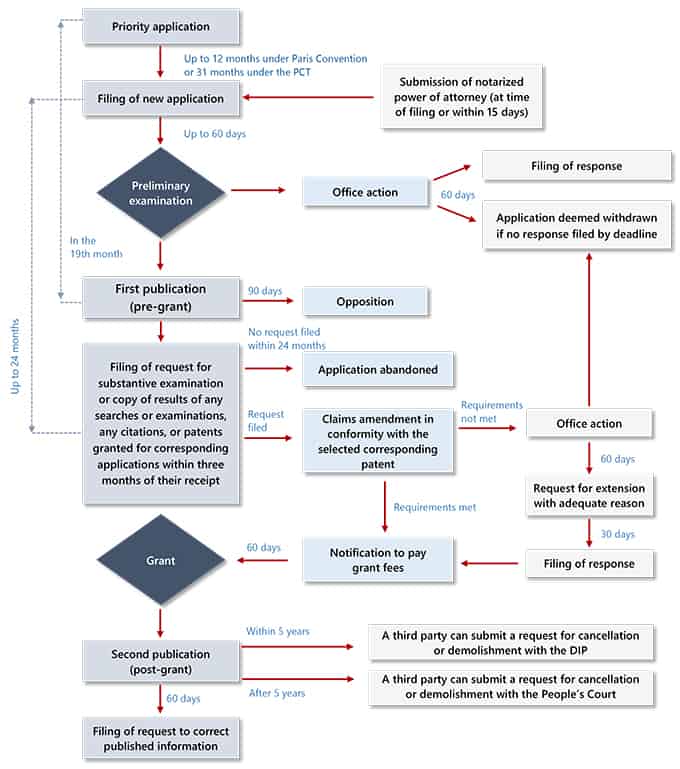
The DIP representatives found the flowchart to be a useful and practice overview, and provided helpful insights on best practices for obtaining a patent in Laos. They also expressed their optimism that the issues of prolonged pendency for patent registration in Laos may finally be improved, with the DIP aiming to decrease the backlog of pending patent applications in the coming few years. The successful realization of this improvement would be positive news for Laos, as it would allow the registration of these crucial rights to be completed in a timely manner, thereby attracting more incoming investment in technology from companies that would be able to rely on legal protections for their patented inventions.


RELATED INSIGHTS​ 

August 13, 2026
Modern agricultural machinery is no longer purely mechanical but instead technology dependent. Modern tractors, harvesters, and other farm equipment increasingly incorporate embedded software, electronic control units, sensors, and digital diagnostic systems. While such technologies enhance efficiency, productivity, and precision farming, they also affect the manner of equipment repair and maintenance. As a result, farmers and independent repair providers may have little practical choice but to rely on authorized dealers, even for routine maintenance and repairs. Section 36 of Thailand’s Patent Act reflects the principle that the authorized sale of a patented invention usually exhausts the exclusive right of the patent owner over the specific product. This means that upon legal sale of the patented product, it can typically be used or resold without further authorization from the patent holder. This principle is relatively straightforward when applied to traditional mechanical equipment. Ownership of a machine ordinarily carries with it the practical ability to diagnose faults, replace worn parts, and restore the equipment to working order. Modern agricultural machinery, however, increasingly depends on embedded software, proprietary diagnostic systems, firmware updates, and other digital resources that may remain under the control of the manufacturer or patent holder. This tension lies within the “right to repair” debate. In the United States, on July 8, 2026, the Federal Trade Commission and five states announced a settlement with Deere & Company resolving allegations that Deere had unlawfully restricted farmers’ and independent repair providers’ ability to repair their equipment. Under the terms of the settlement, for the next ten years, Deere must provide repair resources, including software capabilities, on terms equivalent to those provided to authorized dealers. The Deere settlement highlights that the nature of ownership is changing, but legal concepts have not kept pace. Traditional patent-law concepts, including patent exhaustion, were developed with physical products
August 10, 2026
Thailand has finalized its social media KYC (“know your customer”) rules under Notification of the Electronic Transactions Commission on Measures to Prevent Technological Crimes for Social Media Service Providers (No. 2), which was published in the Government Gazette on May 5, 2026, and will take effect on November 1, 2026. While an early draft of the notification proposed requiring social media platforms to arrange identification of every user account, the final notification is significantly more targeted, focusing on paid online advertising and advertiser identity verification. Though the regulatory initiative primarily aims to combat online fraud and technology-related crimes, it also has important consequences for intellectual property enforcement, because the verified platform records that will be generated under the new requirements can help IP rights holders to identify anonymous online infringers. Key Regulatory Mandates The notification requires social media service providers to verify the identity of advertisers before their paid advertisements are published and disseminated in Thailand through social media, regardless of whether the advertising fees come from the advertisers or third parties. Verification of an advertiser is valid for one year, after which verification would have to be performed again before the platform could publish additional paid advertisements from the advertiser. Permitted verification methods are specified under the notification. A platform may verify an advertiser by checking identity evidence and confirming the connection between the advertiser and that identity evidence, with the notification giving facial comparison against certain government-issued identity documents as an example. Alternatively, platforms may verify advertisers through a digital identity verification and authentication system with an identity-proofing assurance level not lower than the level prescribed by Thailand’s Electronic Transactions Commission. The notification further requires platforms to retain only the advertiser’s information necessary to identify the advertiser, beginning from the start of the advertising activity and for
August 6, 2026
Introduction: A Trademark Paradox in Sustainable Packaging Walk into any Thai supermarket, and the label-free water bottle is no longer a novelty. Thailand’s packaging market, valued at approximately USD 15.68 billion in 2025, is shifting toward minimalist, plastic-light designs as ESG pressures reshape how brands present their products. The country generated roughly 5.68 million tons of plastic waste in 2021, with a recycling rate of only 19 percent, and regulators are now considering rules that would allow label-free bottled water relying on embossing, laser printing, or QR codes instead of wrap-around labels. As packaging itself becomes the brand identifier, a paradox emerges: designs built to say the least often struggle hardest for protection under Thai intellectual property law. The Trademark Barrier: When Shape Is Not Enough Section 7, paragraph 2(10) of the Thai Trademark Act deems a shape distinctive only if it is not the natural form of the goods, is not necessary to achieve a technical result, and does not add value to the goods. The Department of Intellectual Property’s 2022 examination guidelines apply this test conservatively, as the following examples illustrate. A plain water bottle relying on subtle contours to signal its brand is typically read as just another bottle, not a source identifier. Acquired distinctiveness offers a theoretical escape route, but it demands extensive evidence of sales, advertising, and consumer recognition—an especially heavy burden for new entrants whose minimalist packaging has not yet achieved market prominence. The result is a structural bias against precisely the design innovation that sustainability goals are meant to encourage. Design Patents: A Partial, Imperfect Substitute Design patent protection, covering a product’s shape, configuration, or ornamentation, appears to offer an alternative route. In practice, it is constrained by the same forces driving the minimalist trend. Because many brands converge on similar solutions—clear
August 4, 2026
Intellectual property (IP) protection sometimes hinges on fame and recognition. However, this alone will not always be sufficient to overcome an IP dispute when it involves contractual obligations or registered rights. Below are five cases from around the world that tackle some of the basic issues in IP registration, ownership, commercialization, and enforcement. 1. USA: Taylor Swift Trademark Application Refused Taylor Swift recently filed a trademark application to register “The Life of a Showgirl,” which is the title of her 12th studio album. When examining a trademark application, the examiner considers various factors before deciding whether it should be registered. One of these factors is whether there is a likelihood of confusion (i.e., would a regular consumer mistake the origin of the trademark). In Taylor Swift’s case, the US Patent and Trademark Office (USPTO) decided that that there would be a risk of confusion. This decision was based on the existing registered trademark, “Confessions of a Showgirl,” owned by Maren Wade, which was registered in 2015. The USPTO refused Taylor Swift’s application based on the shared key distinctive element “of a showgirl,” the lack of sufficient distinguishing terms, the marks being used in overlapping markets (entertainment and performances), and because consumers may assume a common commercial source. Maren Wade then filed a lawsuit in California against Taylor Swift and her affiliated companies, arguing that Taylor Swfit’s branding is confusingly similar in structure, wording, and overall commercial impression to her registered mark. She is also drawing on the USPTO’s refusal of Taylor Swift’s application to support her argument of a likelihood of confusion. A judgment has not yet been reached in this case, but it serves as an important reminder of the importance of satisfying the essential elements required for IP registration. 2. Australia: Katy Perry v. Katie Perry In