You are using an outdated browser and your browsing experience will not be optimal. Please update to the latest version of Microsoft Edge, Google Chrome or Mozilla Firefox. Install Microsoft Edge

September 28, 2023

Registering Industrial Designs for Household Appliances in Vietnam, Indonesia, and Thailand

Protecting the aesthetic features of consumer items, such as household appliances, is essential for businesses looking to gain a competitive edge, particularly in the dynamic markets of Vietnam, Indonesia, and Thailand. Industrial design registrations (or design patents in Thailand) provide an effective means to protect the unique and ornamental designs of products, ensuring that their distinctive appearance is not imitated by competitors. This article provides a general overview of design systems in Vietnam, Indonesia, and Thailand, as well as some key considerations for businesses and rights holders.

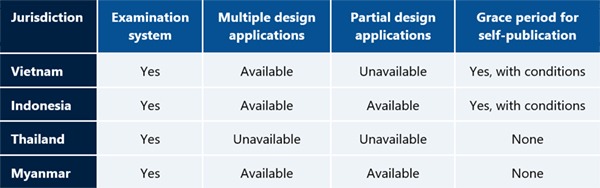
All three of these countries use an examination system for assessing applications to protect designs. While all three jurisdictions are members of the Paris Convention, only Vietnam has fully completed the process of becoming a member of the Hague Agreement. The table below offers a general comparison of the three countries’ design systems, with additional details provided in the subsequent sections.
Vietnam

Owners of a household appliance design may seek design rights in Vietnam by filing a national design application at the Vietnam IP Office or by filing an international design application designating Vietnam either directly with the World Intellectual Property Organization (WIPO) or indirectly through the office of the applicant’s contracting party under the Hague Agreement.

Vietnam’s 2022 IP Law redefines “industrial design” as the external appearance of a product or part thereof to be assembled into a complex product, represented by shapes, lines, colors, or a combination thereof, and visible in the process of exploiting the utility of the product or complex product.

The two options for obtaining design rights in Vietnam are detailed below.

Vietnam National Design Application

As Vietnam is a signatory to the Paris Convention, applicants are entitled to a six-month convention priority period from the filing date of the corresponding application in another jurisdiction. Under Vietnam’s IP Law, an applied-for industrial design is deemed not to have lost its novelty if in the preceding six months it was published without permission from the person with the right to register it, was published by that person in a scientific presentation, or was displayed by that person at a national exhibition in Vietnam or at an official or officially recognized international exhibition.

Design applications must include clear and detailed drawings or photographs of the design, along with a description of the design. The title of the design must also identify the article under the industrial design application.

A valid design application can be published and then substantively examined in Vietnam. After being granted, a design certificate is valid for five years from the filing date, renewable for two consecutive five-year terms.

International Design Application Designating Vietnam

The Hague Agreement concerning the International Registration of Industrial Designs (Geneva Act of July 2, 1999) officially took effect in Vietnam on December 30, 2019. Hague System users can now designate Vietnam in an international design application.

Vietnam does not publish international design registrations in its own official gazette. However, an international design application can be substantively examined in Vietnam. If the IP Office finds any defects, it will issue a notification of refusal within six months of the international publication date. The applicant then has three months to file a response to the refusal, with the possibility of a single three-month extension.

The IP Office will issue a statement granting protection of the design if no defects are identified or if all identified defects have been remedied. The term of protection is 15 years from the registration date.

The international design application option for Vietnam contrasts with Thailand and Indonesia, which are currently not available as designated countries under the Hague System. Applications for these countries must be filed through their respective national pathways, as further explained below.

Indonesia

Industrial design applications in Indonesia are substantively examined for novelty. An industrial design is novel if on the filing date it is not the same as any previous disclosure—that is, any disclosure before the filing date or priority date of another application within or outside of Indonesia.

Indonesia does offer multiple-design applications covering a set of industrial designs that constitute a unified industrial design or that are within the same classification. Different embodiments of the same industrial design must be filed in separate applications.

Partial design applications are also available. The part of the design that is not claimed should be indicated with dashed lines.

There is a six-month grace period before the filing date of an industrial design, during which it is considered to still maintain its novelty. To benefit from this grace period, the industrial design must have been displayed in a national or international exhibition that is official or deemed to be official, or the industrial design may have been used by the designer in an experiment for education, research, or development purposes.

There is no annuity fee for industrial designs, and the protection period is 10 years from the filing date. There is no protection for unregistered industrial designs in Indonesia.

Thailand

Design patent applications in Thailand are subject to an examination system. The protection term for a design patent is 10 years from the filing date. A novelty requirement is an essential element of design patent applications. Thai examiners conduct a search and determine the novelty of a design, along with other requirements. An examiner who deems that a design lacks novelty may issue an examination report along with a rejection decision, potentially leading to an appeals process before the Board of Patents. To avoid this complication, applicants should safeguard the novelty of their design by retaining confidentiality and conducting a prior-art search for the design.

Unlike in Indonesia, neither multiple nor partial design applications are available in Thailand. The grace period mechanism, which allows inventors to disclose their work publicly for a limited time without forfeiting novelty, is limited to exhibitions that have been sponsored or authorized and held in Thailand by the Thai government. Therefore, the grace period cannot be applied to publication by inventors or applicants on any other channels. While there are proposed amendments to the Patent Act that would allow partial or related design applications and expand the grace period mechanism, these are still working their way through the legislative process.

In recent years, requisitions with regard to formality examinations for design patent applications have grown stricter. Examiners may issue an office action requesting that drawings be amended so the lines are sufficiently sharp and clear, with no blurriness or shaded areas. For designs related to appliances, there might also be requisitions concerning both the title of the design and the title indicated in the claims to ensure that the title is directed at an essential feature of the design. Applicants can mitigate these potential issues by researching generally accepted titles using an online database or consulting local counsel.

Why Register Designs?

In the rapidly evolving landscape of household appliance innovation, safeguarding the distinctiveness and uniqueness of designs is an important consideration. Vietnam, Indonesia, and Thailand, as regional drivers of industrial growth and technological advancement, present significant opportunities for manufacturers and designers to secure their creative assets through registration. Beyond legal protection, a registered industrial design can be a catalyst for market differentiation, bolstering brand identity and consumer loyalty. By investing in the protection of their industrial designs, companies secure a competitive edge. The future of the household appliance industry hinges not only on technological advancement but also on the foresight to protect the aesthetics that define it.


RELATED INSIGHTS​ 

September 24, 2026
Vietnam is implementing and developing a broad package of regulatory reforms that could reshape how IP, data, digital platforms, and product authenticity are regulated and enforced. Several of the key measures have been led by the Ministry of Public Security in its legislative and administrative capacity, as part of a broader government effort. The core reform package consists of four key legal instruments: proposed amendments to the Criminal Code, a proposed new Data Security Law, a draft Decree on Product Identification, Authentication and Traceability, and the newly enacted Decree No. 330/2026/ND-CP. These instruments include rules on criminal enforcement, data security, electronic identification, product identification and traceability, administrative violations, and cybersecurity sanctions. Combined, these measures will affect copyright enforcement, industrial property rights, trade secrets, AI training data, product provenance, online takedowns, valuation of counterfeit goods and electronic evidence. It is worth noting that, in addition to strengthening criminal penalties for IP crimes, Vietnam’s emerging regulatory framework increasingly treats infringement, data misuse, product authentication, and platform-enabled violations as interconnected regulatory and enforcement challenges. For rights holders and foreign investors, this could mean stronger tools against counterfeiting and online infringement, but also more compliance obligations around data, traceability, AI, platform controls and government-facing reporting. Expansion of Criminal IP Enforcement Proposed amendments to Article 225 of the Criminal Code would expand criminal copyright exposure beyond reproduction and distribution to cover large-scale commercial public performance and online communication of works, phonograms and video recordings. This is important because piracy is increasingly about streaming, unauthorized communication, and platform access models rather than physical copying. Aggravated copyright infringement could be subject to up to 10 years in prison for individuals and fines of up to VND 6 billion (about USD 228,300) for commercial legal entities. The amended Article 226 would expand criminal industrial property liability beyond
September 17, 2026
Thailand’s Office of the Consumer Protection Board (OCPB) has released for public comment a draft bill to amend the Consumer Protection Act B.E. 2522 (1979), the country’s foundational consumer protection legislation. The draft amendment aims to modernize the nearly five-decade-old framework to address the rapid growth of digital commerce, online advertising, influencer marketing, and new business models. The public consultation period is open until October 10, 2026. Expanded Definitions Covering Digital Commerce The draft significantly broadens several core definitions to capture modern commercial activities: “Consumer” is expanded to include natural persons and nonprofit juristic persons who purchase or receive services, including those solicited by businesses and end users who do not directly pay for the goods or services. “Business operator” now explicitly covers advertising business operators and hired advertising persons, such as influencers and content creators. “Advertising media” is expanded to include digital platforms, social media, and social media user accounts. “Label” now encompasses electronic labels—symbols, codes, or other electronic formats displaying product information. Influencer and Advertising Disclosure Requirements In addition to these expanded definitions, “hired advertising person for selling goods or services” is a new definition covering influencers, content creators, live streamers, affiliate marketers, and virtual online media operators who receive monetary compensation or other benefits for advertising goods or services. Hired advertising persons—including influencers and content creators—must disclose to consumers that content is advertising and reveal their relationship with the business owner. Disclosure is required when the business owner employs the advertiser, pays or provides other benefits for the advertisement, or provides free or discounted products or services. These requirements apply where consumers would not otherwise know that the business has a connection to the person presenting the content. Labeling Requirements for Importers The draft introduces a clearer labeling obligation for importers of label-controlled goods, who must
August 27, 2026
Franchising in Thailand has matured into a sizeable commercial sector, but the rules governing franchisor–franchisee relationships remain scattered across general legislation rather than consolidated in a dedicated franchise statute. In this environment, the decisions of the Trade Competition Commission of Thailand (TCCT) have emerged as valuable practical guidance. Thailand follows a civil-law system in which judicial and administrative decisions do not create binding precedent; however, past rulings are nonetheless influential. This article examines the most instructive recent TCCT decisions and distills the practical compliance considerations for franchisors and franchisees operating in Thailand. Postcontract Changes: Justified or Unfair? A recurring issue is whether a franchisor may alter the terms of engagement after contract execution. The TCCT has established that midterm modifications are not inherently unfair; the determinative factors are whether there was a reasonable business justification, adequate advance notice, and a transparent process. In a 2023 coffee franchise matter, for instance, the TCCT declined to find a violation where a franchisor increased raw material prices, noting the increase had been communicated in advance and supported by demonstrable cost pressures. A bubble tea franchise matter reinforces this principle. The TCCT found that postcontract mandatory purchases of branded syrup and flavorings were justified, as the agreement reserved the franchisor’s right to modify product requirements, the materials were sold at or below market prices, and the branded ingredients possessed distinctive qualities deemed essential to franchise quality. The complaint was dismissed, with the additional requirements characterized as a legitimate measure to preserve brand consistency. Considered together, these decisions indicate that post‑contract modifications will be evaluated against three criteria: (1) whether there is a legitimate business rationale, (2) whether adequate advance notice was provided, and (3) whether franchisees were treated equitably throughout the transition. Discriminatory Treatment: Are Renewals and Information Equal? A 2024 automotive dealership
August 20, 2026
As part of its membership in Lex Mundi, Tilleke & Gibbins has released the latest edition of its Guide to Doing Business in Thailand, providing an overview of the legal, regulatory, and commercial considerations for companies establishing or expanding operations in Thailand. The 2026 edition offers practical insight into the country’s business environment, investment framework, and operational requirements. The guide covers a wide range of topics relevant to foreign and domestic investors, including: Investment incentives and promotion schemes Financial facilities and banking regulations Exchange controls and money transfers Import and export regulations Business structures and incorporation options Requirements for establishing a business Operational and compliance considerations Business cessation and insolvency procedures Employment and labor laws Taxation Immigration and visa requirements Prepared by Tilleke & Gibbins lawyers across multiple practice areas, the publication outlines key aspects of doing business in Thailand, including foreign investment restrictions, regulatory compliance obligations, corporate structures, employment requirements, and recent legal and economic developments affecting investors. The publication forms part of Lex Mundi’s Country Guides series, a global collection of jurisdiction-specific reference materials prepared by member firms around the world. Together, these guides help companies evaluate opportunities, compare regulatory environments, and plan international business activities across multiple markets. The full Guide to Doing Business in Thailand 2026 is available through the button below.