
You are using an outdated browser and your browsing experience will not be optimal. Please update to the latest version of Microsoft Edge, Google Chrome or Mozilla Firefox. Install Microsoft Edge

May 25, 2018

Myanmar Opens Retail and Wholesale Business to 100% Foreign-Owned Companies

Informed Counsel

On May 9, 2018, Myanmar’s Ministry of Commerce (MoC) issued Directive 25/2018 (the Directive) permitting 100% foreign-owned companies, and joint venture companies established between Myanmar citizens and non-Myanmar citizens, to conduct retail or wholesale business in Myanmar, provided that they meet minimum initial investment requirements, register with the MoC, and comply with certain operational restrictions.

Initial Investment Capital

To qualify under the Directive, companies must meet certain minimum initial investment requirements. Foreign-owned companies, and joint ventures in which Myanmar citizens own less than 20% of the direct share equity, require more initial investment capital than companies with 20% or more direct share equity owned by Myanmar citizens, as detailed below.

Minimum Initial Investment for Retail and Wholesale Business in Myanmar
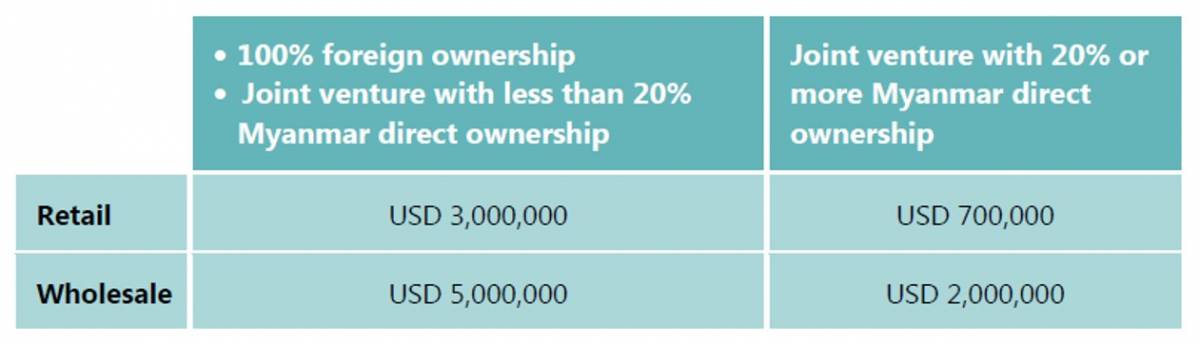
For the purposes of the Directive, initial investment capital does not include the cost of leasing land.

MoC Registration

Any company intending to operate a retail or wholesale business under the Directive must register with the MoC by supplying the following documents:

  • Certificate of company registration
  • Copy of the company’s Myanmar Investment Commission (MIC) endorsement, (or MIC permit if the company falls under the MIC permit requirement scheme)
  • Recommendation letter from the relevant City Development Committee or Township Development Committee of the region or state
  • Lists of group of goods to be sold retail or wholesale
  • Detailed descriptions of the business plan prescribing the amount of initial capital investment, the location, and the area to be occupied in square meters

Any existing company registered under the Directive that wishes to open a new branch or outlet must provide 90-days’ notice to the MoC.

In addition, the Directive expressly entitles Myanmar citizens to operate retail or wholesale businesses with any amount of initial investment capital. However, if these businesses are already in operation, and their initial investment capital was equivalent to USD 700,000 or more, they must register with the MoC within 150 days of the issuance of the Directive.

Operational Restrictions

Companies established under the Directive must not:

  • operate a retail or wholesale premises, including minimarkets and convenience stores, with a floor area of less than 929 square meters;
  • operate a business outside the times, days, and location prescribed by the development committee of the relevant region, state, city, or other local authorities;
  • distribute unsafe or substandard goods in breach of relevant laws; or
  • sell goods prohibited under the law.

In addition, companies have a duty to cooperate with the MoC to support their efficient supervision and enforcement of the law.

This represents a major relaxation of business operational requirements in the Myanmar retail sector, and opens the door for large-scale foreign investment in this burgeoning economy.

RELATED INSIGHTS​ 

September 4, 2026
Foreign business restrictions on telecommunications, treasury center businesses, and intragroup support services were eased when Thailand published the Ministerial Regulation Prescribing Service Businesses Not Requiring Permission for Foreign Business Operations (No. 5) B.E. 2569 (2026) in the Government Gazette on August 28, 2026. The ministerial regulation expands the categories of service businesses that foreign investors may operate without a foreign business license (FBL) under the Foreign Business Act B.E. 2542 (1999) (FBA). Of particular relevance to the telecommunications, fintech, and technology sectors, the ministerial regulation exempts: Type 1 telecommunications licensees, which do not have their own networks; Treasury center businesses operated in accordance with Thailand’s exchange control regulations; and Certain intragroup administrative, human resources, and information technology management services. Telecommunications Services Foreign-owned businesses providing telecommunications services under a type 1 telecommunications license may now operate without obtaining an FBL. This may streamline market entry for qualifying telecommunications and digital infrastructure businesses. The exemption applies only to the FBA licensing requirement. Operators must continue to comply with applicable requirements under the Telecommunications Business Act and the regulations of the National Broadcasting and Telecommunications Commission, and the change does not affect foreign ownership restrictions applicable to type 2 or type 3 telecommunications businesses. Treasury Center Businesses The ministerial regulation also exempts qualifying treasury center businesses from the FBL requirement. This may facilitate centralized treasury functions in Thailand, including liquidity management, foreign exchange management, and intragroup funding arrangements. Treasury center operations remain subject to applicable requirements of the Bank of Thailand and other competent authorities. Intragroup Administrative, HR, and IT Services Certain administrative, human resources, and information technology management services provided between affiliated entities are also exempt, provided the relevant entities satisfy prescribed ownership or management criteria. The exemption is available where the service provider and recipient are related through specified ownership
September 1, 2026
Thailand has taken another step toward liberalizing its foreign business framework, exempting additional service activities and derivatives brokerage or agency businesses from the licensing requirements of the Foreign Business Act (FBA). Since the FBA came into effect, Thailand has taken a measured approach to opening its economy to foreign investment. While the FBA regulates foreign participation in businesses that may affect domestic interests, the framework has also evolved to allow foreign participation in certain business activities where sector-specific laws and regulatory frameworks already provide sufficient oversight, making additional FBA restrictions unnecessary. This is particularly true where Thai businesses are sufficiently capable of competing in certain service sectors, or where liberalization is intended to facilitate the provision of services among companies within the same corporate group. Against this backdrop, two new ministerial regulations have been issued pursuant to the FBA. Service Businesses Under the FBA Under the FBA, certain categories of business are restricted for foreign operators. List 3 of the FBA sets out businesses that foreigners may operate only if they obtain a foreign business license (FBL) or a foreign business certificate (FBC), or unless a specific exemption applies. List 3 (21) covers “other service businesses,” which is a catch-all provision that captures a wide range of service businesses not specifically enumerated elsewhere in the FBA. In practice, this means that most service activities carried on by foreigners in Thailand require an FBL or FBC unless otherwise exempted. Notwithstanding the foregoing, the FBA provides a mechanism to address this breadth by empowering the Minister of Commerce to issue ministerial regulations excluding specific types of service businesses from List Three (21). Once a service business is so excluded, foreigners may operate it without obtaining an FBL or FBC. Prior to the new regulations, four ministerial regulations had been issued to
August 31, 2026
Thailand has introduced a new regulatory framework that may expose foreign nationals who violate the Foreign Business Act (FBA) to deportation. The Regulation of the Office of the Prime Minister on Deportation B.E. 2569 was published in the Government Gazette on August 27, 2026. The regulation establishes an administrative process for referring foreign nationals for deportation where this is deemed necessary in the interests of public order or public morality. It does not create new substantive deportation powers, but it expressly identifies unlawful business conduct under the FBA—including nominee arrangements—as grounds for referral. Grounds for Deportation Referral The regulation sets out five grounds that may give rise to a referral to the relevant authorities: Unlawful entry into, or unlawful stay in, Thailand in violation of immigration laws. Unlawful employment or engagement in work in violation of laws governing the employment of foreign nationals. Carrying on business in violation of the FBA, including through the use of nominee arrangements. Forging official documents or using forged official documents. Committing an offense punishable by imprisonment of five years or more. The framework takes a broad approach, extending not only to the perpetrators of these acts but also to those who facilitate, instigate, or otherwise support such acts. Deportation Risk Following a Criminal Judgment Where a foreign national has committed any of the above offenses and has fully served the sentence imposed pursuant to a final judgment, the interior minister has the power to order deportation. This power also applies where a court has issued a final judgment sentencing a foreign national to imprisonment but has suspended the execution of the sentence, or has imposed a fine. A deportation order may also specify a period during which the foreign national is prohibited from reentering Thailand. FBA Noncompliance: Broader Consequences Noncompliance with the FBA—including
August 24, 2026
Myanmar’s Directorate of Investment and Company Administration (DICA) has published the guidelines it uses to assess and approve company names for registration in the country. The guidelines, which were published on May 18, 2026, explain how DICA determines whether a proposed name is identical or too similar to an existing name, and they identify words and expressions that may be prohibited or restricted. Businesses planning to incorporate in Myanmar should expect DICA to scrutinize proposed names more closely than it has in the past. Prohibitions on Company Names The Myanmar Companies Law prohibits company names that are identical or similar to existing company names, and DICA’s internal assessment guidelines explain how this rule applies in practice. Under the guidelines, DICA may reject a proposed company name if the proposed name: Is identical or nearly identical to an existing company name; Differs from an existing company name only in punctuation, capitalization, spelling, or transliteration; Only adds words such as “Group,” “Holding,” “International,” “Myanmar,” or “Family” to an existing company name; Merely rearranges the words in an existing company name; Is pronounced similarly to an existing name; Uses the same brand name as an existing company, even if the company carries out different business activities; or Uses an existing brand name together with an abbreviation of that brand name or a shortened form of the name or business description. DICA may also consider whether a proposed name could give the impression that two companies are related, even if they operate in different business sectors. In addition, DICA may review a company name even after registration. If it later determines that the name does not comply with the Myanmar Companies Law or is otherwise unsuitable, DICA may direct the company to change its name under section 26 of the Myanmar Companies Law.