You are using an outdated browser and your browsing experience will not be optimal. Please update to the latest version of Microsoft Edge, Google Chrome or Mozilla Firefox. Install Microsoft Edge

April 10, 2020

Cambodia Issues Tax Relief Measures for Textile and Garment Enterprises to Mitigate EBA Suspension

On March 24, 2020, Cambodia’s Ministry of Economy and Finance issued Prakas No. 319 MoEF.Br.K on Tax Measures to Mitigate the Effect of Challenges on Textile and Garment Enterprises.

This prakas provides income tax exemptions to factories and enterprises in the textile, garment, footwear, bag, handbag, and hat sectors that are affected by the partial suspension of the European Union’s Everything but Arms (EBA) preferential tariff scheme.

Companies will receive an income tax exemption for the 2020 tax year based on how the partial suspension of EBA has affected their business. The formula for determining the level of the effect is set out below:
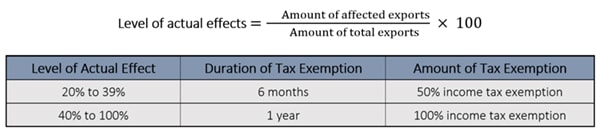
In order to qualify for the above income tax exemptions, companies must submit documentary evidence to quantify the effect of the partial EBA suspension to the General Department of Taxation when submitting their annual income tax returns.

For more details on this tax relief measure, or on any aspect of conducting business in Cambodia, to Tilleke & Gibbins at [email protected].

RELATED INSIGHTS​ 

December 12, 2025
Similar to other types of corporate disputes, tax-related conflicts often begin with an earnest attempt to resolve matters outside the courtroom. The prospect of engaging in tax litigation can be daunting, given the potential strain on commercial relationships, the legal expenses, and the uncertainty surrounding its resolution. However, there are instances when tax litigation becomes the sole avenue for seeking redress. For individuals and entities contemplating the pursuit of tax-related legal remedies, the Thai legal system offers an accessible, impartial, and equitable platform for dispute resolution. Tilleke & Gibbins’ latest update to Tax Litigation in Thailand provides an outline for navigating tax-related disputes within the Thai legal framework. It aims to equip readers with a fundamental understanding of procedures and practices within the Thai tax litigation landscape. The full guide is available through the button below.
October 30, 2025
Thailand has introduced a comprehensive overhaul of its tax litigation procedures that will significantly impact how tax disputes are handled. The Regulations for Tax Cases B.E. 2568 (2025) take effect on November 24, 2025, and repeal the prior B.E. 2544 (2001) regulations in full. These regulations support the implementation of the Act on the Establishment of the Tax Court and Tax Case Procedure (No. 3) B.E. 2568 (2025), which expands the Tax Court’s jurisdiction to certain criminal tax matters. Published in the Government Gazette on October 14, 2025, the regulations have been reorganized into three parts covering civil cases, criminal cases, and forms, and are designed to accelerate proceedings, tighten evidentiary discipline, and modernize court operations. Structural Reform and Scope The prior regime governed only civil tax disputes. Under the new framework, the regulations introduce a dedicated chapter for criminal cases alongside updated civil procedures, as the Tax Court now has express authority to adjudicate specified criminal tax offenses. Select mechanisms applied in civil case proceedings, such as electronic communication, recording testimony, and appointing experts, also apply to criminal proceedings mutatis mutandis where they do not conflict with criminal procedure. Civil Cases: Evidence Submission, Deadlines, and Scheduling Parties must submit, together with the witness list, originals of all documentary evidence, media, or electronic data (such as files, USB drives, or CDs), and all physical evidence in the party’s possession. Failure to submit any original within the deadline (see below) results in a loss of the right to adduce that item at trial, subject only to narrow exceptions where submission is impossible due to force majeure or where receipt of the evidence is indispensable to the interests of justice. The practical impact is that parties are now obligated to assemble and verify all original documents and data at the very
September 17, 2025
Thailand’s Ministry of Finance has introduced a five-year personal income tax exemption on capital gains from the disposal of cryptocurrency or digital tokens. The Ministerial Regulation No. 399, published in the Government Gazette on September 5, 2025, offers the personal income tax exemption for transfers occurring between January 1, 2025, and December 31, 2029. The ministerial regulation was enacted to promote Thailand as a global financial center and digital asset business hub while encouraging increased domestic investment in digital assets. Key Conditions The exemption, which covers capital gains from cryptocurrency and digital token disposals during the specified five-year period, applies only to individuals. Companies that trade in digital assets are not eligible for this tax exemption. With the tax holiday set to expire in 2029 (unless extended), individual traders should plan ahead for postexemption taxation to ensure full compliance with Thailand’s personal income tax requirements. Proper documentation of digital asset transactions during the exemption period will be essential for future tax compliance. For more details on this tax exemption, or on any aspect of Thailand’s tax law and regulations, please contact Saravut Krailadsiri at [email protected] or Papavarin Sarawongsuth at [email protected].
July 7, 2025
On June 20, 2025, Cambodia’s Ministry of Economy and Finance issued Instruction No. 19116 to clarify when board members and company directors must receive salaries and pay payroll taxes. Board members and company directors who are not considered employees are subject to a withholding tax. This category consists of people who complete services for a nonresident individual and people who perform independent work for a company in Cambodia. Board members and company directors who are considered employees, including those appointed by a foreign head office to temporarily manage a company in Cambodia, must pay payroll taxes on any salary they receive, regardless of whether they are paid by a local or foreign branch of the company. The above obligations apply regardless of whether the person has a work permit. Board members and company directors are exempt from paying payroll tax if they: Are not present and not performing a regular management role at the company despite being registered on the company’s statutes or patent tax card; Participate only in board meetings and occasional shareholder meetings; and Do not receive a salary from a company in Cambodia. Overall, this instruction provides an important clarification regarding the tax obligations of board members and company directors. Companies should pay attention to the classification of their board members and directors and be mindful of the exemption.   This article was written with the assistance of Tilleke & Gibbins interns Amelia Gemma Erickson and Amrin Keat.